One Photo per Room: A Room-by-Room Home Safety Checklist
Short answer: Walk your home with a phone and take one photo per room from the doorway, with the floor and the light in frame. Photos show what familiar eyes skip: rug edges, dark paths, high shelves. Start with the bed-to-bathroom path.
You could walk your house with your eyes closed. Some nights, you more or less do.
That familiarity is a strength. It is also why hazards hide. After a few years, the curled rug corner, the bulb that went dim, and the basket parked by the stairs stop registering. They become part of the furniture.
A photo has no such habit. It shows the room the way a visitor sees it, and it lets you look hard at the house without anyone looking hard at you.
Why the rooms deserve the attention
Most injurious falls among older adults happen at home, and three places lead the list: the bedroom, the stairs, and the bathroom. Looking room by room puts your attention on what you can change: floors, light, rails, and reach.
CDC says more than one in four older adults falls each year, and less than half tell their doctor (CDC). CDC lists home hazards, such as broken or uneven steps and throw rugs or clutter, among the risk factors that can be changed.
Where falls happen is just as telling. In a CDC analysis of emergency department visits for falls among older adults living in the community, 79.2 percent of falls with a known location happened at home. Where the room was recorded, the bedroom accounted for 25 percent, the stairs 22.9 percent, and the bathroom 22.7 percent. For people 85 and older, the bedroom share rose to 31.6 percent (Moreland et al., CDC researchers).
That is why we say: blame the house, not the person. A threshold that catches a slipper is a feature of the house. Fixing it admits nothing about you.
How to take the photos
Stand in the doorway and include the floor. Photograph each room as it is on an ordinary evening, with the lights you actually use. One photo per room is enough to start, and you decide who sees them.
- Doorway, then floor. Stand where you usually walk in and tilt the phone down a little so the floor fills the bottom of the picture. Most trip hazards live there.
- Skip the tidying. The goal is the room on an ordinary Tuesday, not the room when company is coming.
- Use your real lighting. Turn on only the lights you normally use.
- Take the hallway and stairs after dark. In most of the country, clocks fall back on Sunday, November 1, and evenings get dark an hour earlier (NIST). That week is a good time to photograph the night path.
- You decide. For your own photos, which rooms, which photos, and who sees them are your call.
Room by room: what to look for in each photo
Look for four things in every photo: what is on the floor, where the light falls, what you would hold, and what you reach for. Then use the room questions below, drawn from CDC and National Institute on Aging guidance.
The questions come from CDC's Check for Safety checklist (CDC STEADI) and the National Institute on Aging's room-by-room guide (NIA).
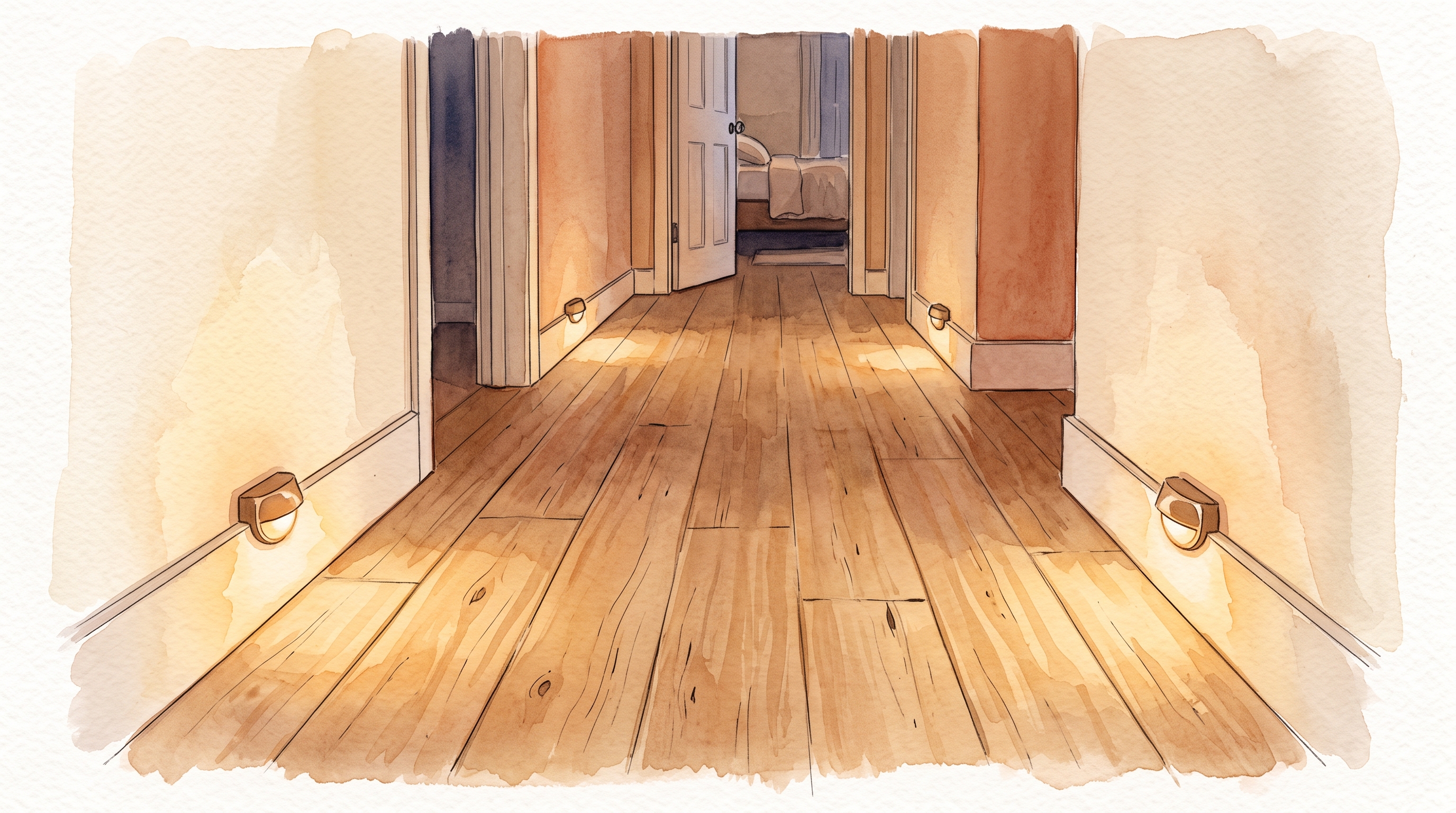
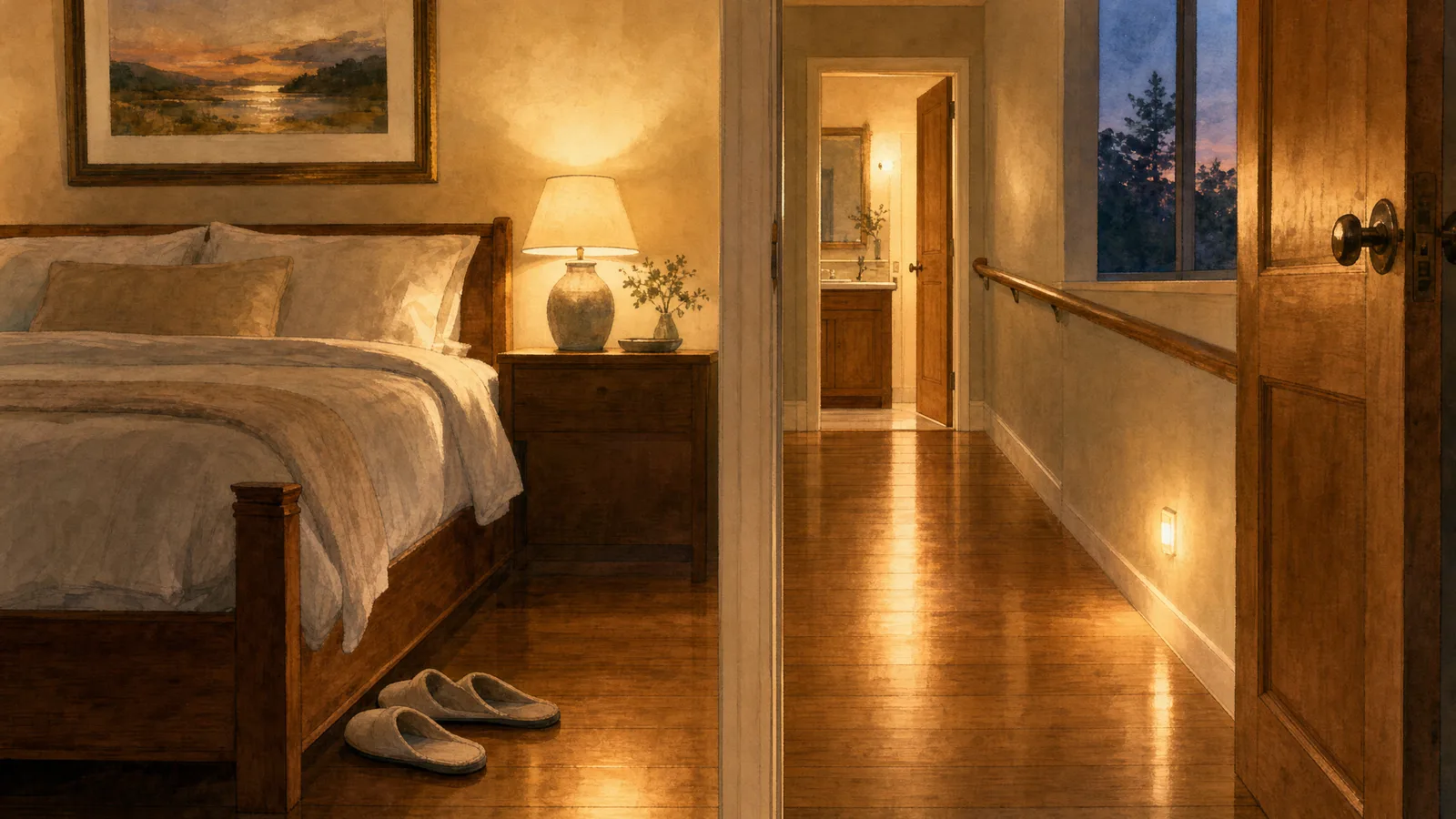
Bedroom. Is the lamp near the bed easy to reach? Is the path to the bathroom dark? A night light that turns on by itself helps. Are a charged phone and a flashlight within reach of the bed? More in bedroom fall hazards.
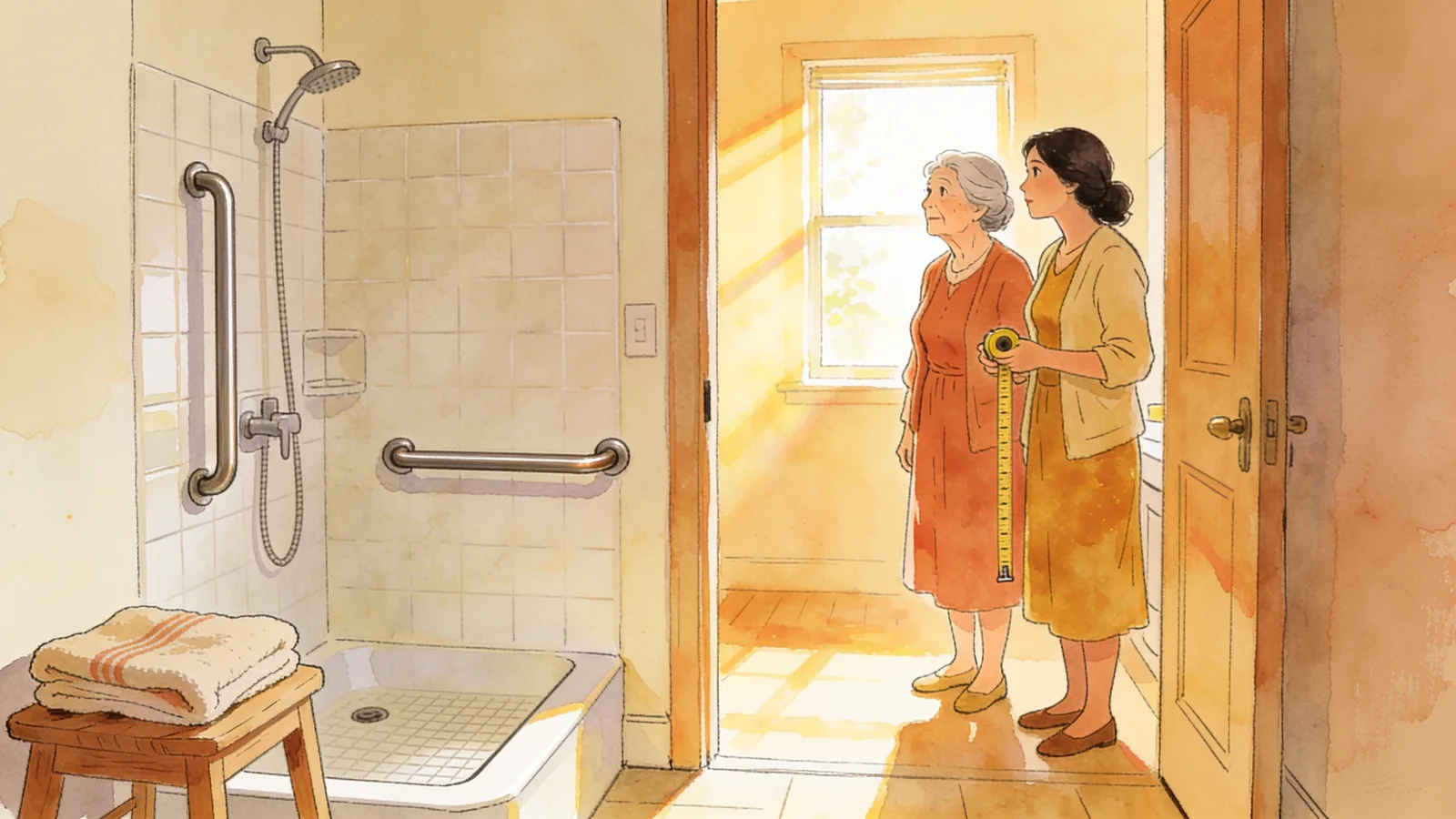
Bathroom. Is the tub or shower floor slippery? Is there something solid to hold when you step in and out, and when you stand up from the toilet? NIA suggests grab bars near toilets and both inside and outside the tub and shower. More in bathroom fall hazards.
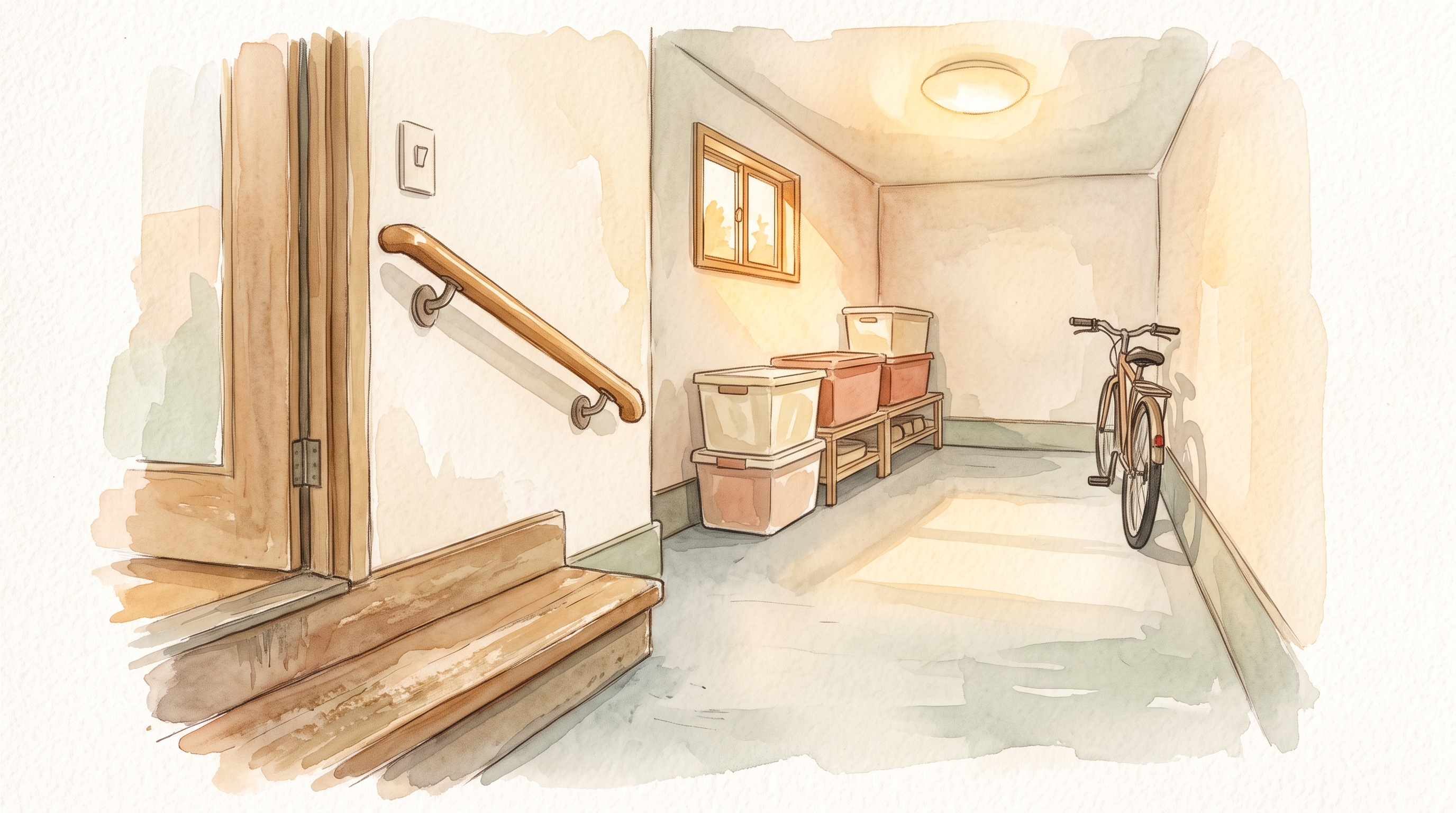
Stairs. Is there a light and a switch at the top and the bottom? Are there handrails on both sides, as long as the stairs? Is anything stored on the steps, or is the carpet loose? More in stair fall hazards.
Hallways and doorways. Do you step over cords? Are there throw rugs without non-slip backing? Is there a raised threshold that reads as flat floor? See door threshold trip hazards, and point night lights at the floor.
Kitchen. Are the things you use most on high shelves? CDC suggests keeping them at about waist height. If you use a step stool, does it have a bar to hold? Never a chair. More in kitchen fall hazards.
Living room. Do you walk around furniture to cross the room? Is your favorite chair easy to get into and out of? More in living room fall hazards.
Entry, porch, and garage. Are the front steps broken or uneven? Is the porch light on when you come home after dark? Are the steps from the garage into the house lit and steady? More in garage fall hazards.
Four ways to look at a home
A paper checklist, your own photos, a Room Safety Check, and an in-person assessment answer different questions. Most households start with the first three and call a professional when the question is about how a person moves.
| CDC Check for Safety | Your own photo walkthrough | Room Safety Check in SeniorThrive | In-person home safety assessment | |
|---|---|---|---|---|
| Who does it | You, with a pen | You, with a phone | You or family, with a phone | Usually an occupational therapist |
| What it looks at | Common hazards, room by room | Each room as it really looks | The room in your photo | How a specific person moves through the home |
| What you get | Questions and suggested fixes | A before picture to compare after a fix | Findings, a Home Safety Score, and a short fix list for that check | Recommendations for that person |
| Cost | Free | Free | Essential for new checks; past reports stay on Free; family members can preview one in their own home for free | Varies by provider and coverage |
| Best for | A first pass | Seeing what you stopped noticing | A clear starting point and a picture you can share | After a fall, a hospital stay, or a change in mobility |
The Room Safety Check shows you the house. An in-person home safety assessment looks at the person in the house.
What to do with the photos
Pick one fix a week and start with the cheapest. Take the same photo again after the fix, so you can see the change. Share the before and after only with the people you choose.
- Cheap and quick first. A night light on the bedroom-to-bathroom path. Cords coiled or taped next to the wall. Everyday dishes moved down a shelf. A throw rug removed or given a non-slip backing.
- Bigger jobs go to a pro. A second handrail, grab bars, or a light switch at the bottom of the stairs. CDC's checklist suggests an electrician for stair lighting.
- Let the house do the talking. A photo turns "Are you being careful?" into "Should this rug stay?" That is an easier conversation for everyone.
In SeniorThrive, a Room Safety Check keeps this simple. Take a photo of the room. SeniorThrive looks at the house and shows what deserves attention. The findings, a Home Safety Score, and a short list of fixes belong to that check. Each room stands on its own, so a clean living room never hides a risky bathroom. Room Safety Check results are shared with everyone in your Circle, so you choose who sees them by choosing who is in your Circle. You can remove anyone at any time.
Take the first photo tonight, from your bedroom doorway, then start free. The Emergency Card is free, and family can set things up at no cost. When you are ready, a Room Safety Check is a gentle next step, starting with the room you think about most.
FAQs
What should a room-by-room home safety checklist include?
Every room: what is on the floor, where the light falls, what you can hold, and what you reach for. Then room-specific questions, such as a lamp within reach of the bed, support at the tub and toilet, and handrails on both sides of the stairs.
Which room should I check first?
Start with the path from your bed to the bathroom, ideally after dark. In a CDC analysis of fall-related emergency visits, the bedroom was the most common place at home for falls with a recorded room, followed by the stairs and the bathroom.
How is a Room Safety Check different from taking my own photos?
Your own photos give you a record to compare. A Room Safety Check in SeniorThrive goes a step further: take a photo of the room, and SeniorThrive shows what deserves attention, with findings, a Home Safety Score, and a short list of fixes for that check.
What does the Home Safety Score show?
The Home Safety Score describes the house room by room, based on Room Safety Checks. Each room stands on its own, so one risky bathroom is never hidden by a tidy living room. It is about the house only, not about the person who lives there.
When should I get an in-person home safety assessment?
Consider one after a fall, a hospital stay, or a change in how you get around. An occupational therapist looks at how you move through your own home. If you have fallen, NIA notes your doctor might suggest a home visit from a therapist or nurse.
Can I do a room-by-room checklist on my own?
Yes. A room-by-room checklist keeps the focus on the house, so you stay in charge of your routines and your choices. Bring in family or a professional only when you want to.
Sources
- CDC, Facts About Older Adult Falls (reviewed Sept 8, 2026). https://www.cdc.gov/falls/data-research/facts-stats/index.html
- Moreland B, Kakara R, Haddad Y, Shakya I, Bergen G. A Descriptive Analysis of Location of Older Adult Falls That Resulted in Emergency Department Visits in the United States, 2015. American Journal of Lifestyle Medicine, 2021. https://pmc.ncbi.nlm.nih.gov/articles/PMC8669898/
- CDC STEADI, Check for Safety: A Home Fall Prevention Checklist for Older Adults. https://stacks.cdc.gov/view/cdc/59197
- National Institute on Aging, Preventing Falls at Home: Room by Room. https://www.nia.nih.gov/health/falls-and-falls-prevention/preventing-falls-home-room-room
- NIST, Daylight Saving Time Rules (2026 dates). https://www.nist.gov/pml/time-and-frequency-division/popular-links/daylight-saving-time-dst
SeniorThrive is not affiliated with or endorsed by the CDC, the National Institute on Aging, or NIST. References are to their public materials. A Room Safety Check and the Home Safety Score describe the house. They are not a medical device, a home inspection, or a clinical assessment.