Your Hallway Has a Three Quarter Inch Step. Here Is Why It Keeps Catching People.
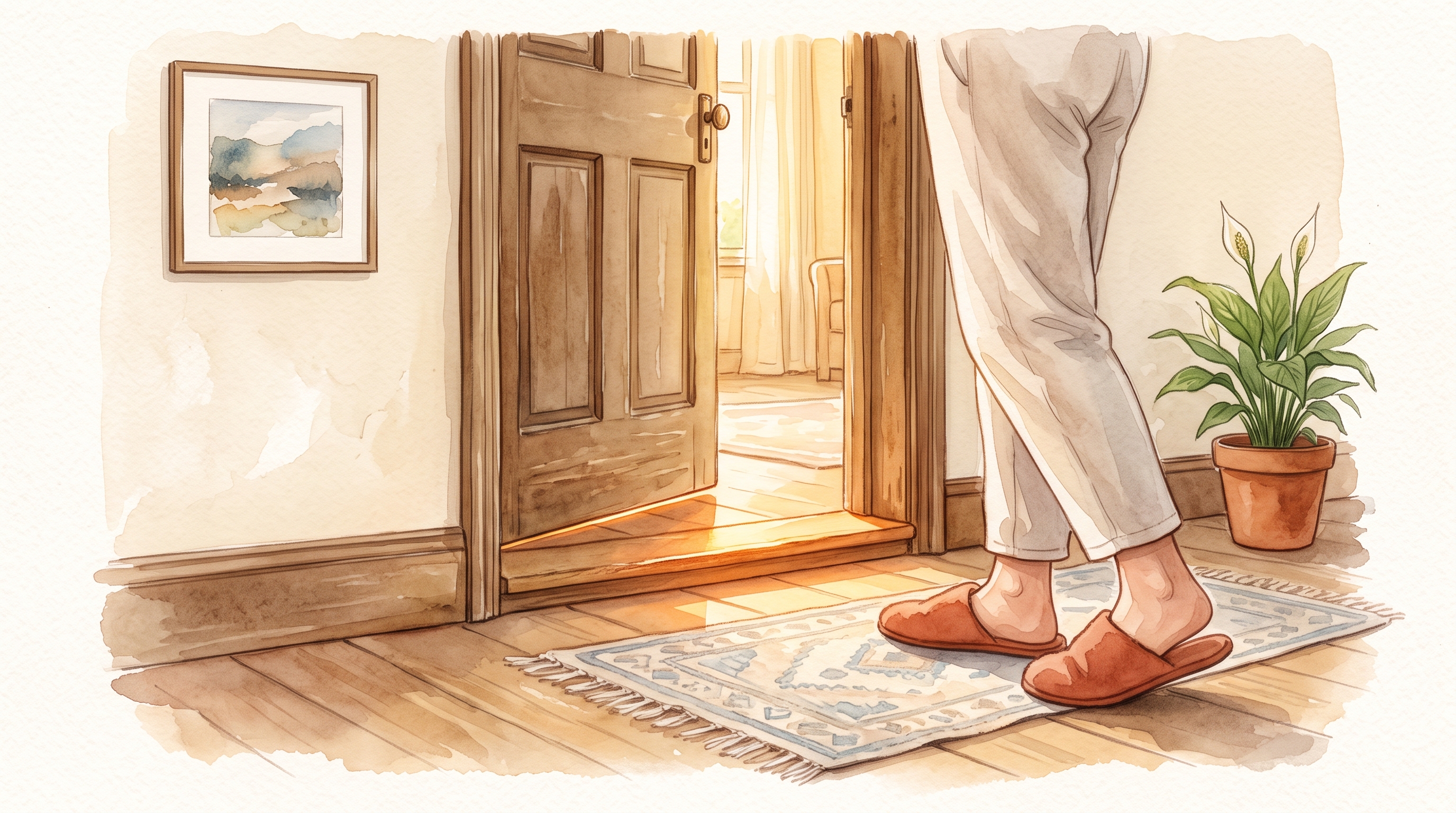
Somewhere in your parent's house there is a step about three quarters of an inch tall. It might be the wooden saddle under the bathroom door. It might be where the hallway carpet meets the kitchen tile. It might be the strip at the back door that keeps out the draft.
Nobody calls it a step. From standing height it reads as floor. That is exactly why it catches people who have walked over it for thirty years.
It is not your parent. It is the house.
Why a small edge trips a steady person
A full stair announces itself. You see it, your body gets ready, you lift your foot. A threshold does none of that. It is too short to register and just tall enough to stop a toe.
Three ordinary changes make it worse over time. People lift their feet a little less as the years go by, so a shuffle that cleared the edge at 60 clips it at 80. Soft house slippers and socks drag where a shoe would glide. And many of these crossings happen at night, half awake, with the light behind you and the edge in shadow.
For a sense of scale: the accessibility standards written for public buildings (the 2010 ADA Standards) let a floor change about a quarter inch before it needs a beveled edge, and anything over a half inch is supposed to be ramped. Plenty of homes have thresholds taller than that in three or four doorways. Nobody built them wrong. They were built for a different decade of the same person's life.
How to find them in ten minutes
Walk the path your parent actually uses, in the order they use it: bed to bathroom, bathroom to kitchen, kitchen to the door they use most. At every doorway and every place one flooring meets another, crouch down and look at it from the side. Standing up, you will miss most of them.
Look for four things:
Raised wood or metal saddles under interior doors, especially bathrooms.
Flooring transitions where carpet, tile, vinyl or wood meet at different heights.
Exterior door sills, which are often the tallest edge in the house.
Rug edges and runners that sit right next to a threshold and double the height.
Then do it once more at night with only the lights your parent would actually turn on.
What to fix, starting with the cheap things
Contrast first. A strip of high-visibility or contrasting tape along the edge costs a few dollars and turns an invisible lip into something the eye catches. This is the fastest fix in the house.
Light the crossing. A motion-activated plug-in light placed low, near the doorway and pointed at the floor, shows the edge instead of shining in your parent's eyes.
Bevel it. Small rubber or aluminum threshold ramps sit over the existing edge and turn a step into a gentle slope. Many are sold for a modest price at hardware stores and online. Measure the height first so the ramp matches it.
Move the rug. If a runner sits against a threshold, pull it back or take it out. That one is free.
Call a pro for the big ones. A tall exterior sill, a threshold that has worked loose, or a sunken floor transition is a job for a handyman or a contractor who does home modifications. Replacing or lowering a threshold is usually a small job, but it is not a guessing job.
A note on safety
Fixing thresholds lowers one kind of risk. It does not make a home fall-proof, and it does not explain every stumble. If your parent has fallen, is tripping more often than before, or feels dizzy or unsteady, call their doctor. Changes in balance, vision, or medication can be part of the picture, and a clinician is the right person to look at that.
Start with one doorway
You do not need to renovate. You need to see the house the way your parent's feet see it. Most of what matters costs less than a dinner out, and most of it can be done this weekend.
SeniorThrive goes room by room with you. Take a photo, and Room Check gives SeniorThrive's read of what is worth fixing first, which fixes you can do yourself, and which ones call for a pro. Everyone in the family can see the same list, including the person who lives there.