Does Your Home Need to Be ADA Compliant? What Actually Applies When You Modify Your House
Short answer: No, in most cases. The ADA covers public accommodations, commercial facilities and government programs, not a privately owned single-family home you're modifying for yourself. Local building codes and permits still apply. Government funding or a home business can change the picture.
A contractor stands in the bathroom, looks at the tub, and says the grab bars "have to be ADA compliant." Suddenly a simple fix sounds like a code project with a code-project price.
For most families, that statement is wrong. Knowing why helps you ask better questions, compare quotes on fair terms, and spend money on what the person living in the house actually needs.
Does the ADA apply to a private home?
Short answer: Generally not. The ADA's building rules reach places of public accommodation, commercial facilities and state and local government. A house you own and live in is a private residence. Housing covered by, or expressly exempted from, the Fair Housing Act is excluded from the ADA's definition of commercial facilities.
The Americans with Disabilities Act is a civil rights law. Its design standards (the 2010 ADA Standards for Accessible Design) tell businesses, public buildings and government entities how to build and alter spaces the public uses.
The U.S. Department of Justice's Title III Technical Assistance Manual explains that housing covered by, or expressly exempted from, the Fair Housing Act is excluded from the ADA's definition of commercial facilities. Your kitchen, your hallway and your shower are not public spaces, so the ADA's standards do not govern them.
One exception worth knowing: if part of a home is used as a place of public accommodation (for example, a professional office where clients come in), the Department of Justice says that portion, plus an accessible route to it, is covered by Title III.
When can accessibility standards apply to home modifications?
Short answer: When public money or public programs are involved, or the building is covered multifamily housing. Section 504, ADA Title II, UFAS and the Fair Housing Act can then come into play. Ask the program or property owner which standards, if any, apply.
Here is where the rules can change:
- Federally assisted housing (Section 504). Section 504 of the Rehabilitation Act bars disability discrimination in programs that receive federal financial assistance. HUD's Section 504 regulations treat buildings designed, built or altered to the Uniform Federal Accessibility Standards (UFAS) (or, since 2014, the 2010 ADA Standards with HUD's exceptions) as compliant, and they set alteration rules for multifamily housing projects.
- State and local government programs (ADA Title II). Title II covers state and local governments' programs, services and activities. If a city or county runs or funds a housing program, its rules may reference accessibility standards.
- Newer multifamily buildings (Fair Housing Act). HUD and the Department of Justice explain that buildings with four or more units built for first occupancy after March 13, 1991 must meet the Act's design and construction requirements. In buildings without an elevator, the requirements apply to ground-floor units.
- Renters (Fair Housing Act). A landlord generally must allow reasonable modifications, such as grab bars, that a tenant with a disability needs. The tenant usually pays and may have to restore the space when moving out. In federally assisted housing, the provider may have to pay instead.
USDA's Section 504 Home Repair program (a separate "504," named for a section of the Housing Act of 1949) offers loans and, for very-low-income homeowners 62 or older, grants to remove health and safety hazards. If you use a program like this, ask the program office what work standards it requires rather than assuming the ADA applies.
What laws and codes apply, by situation
| Your situation | Do ADA Standards legally apply? | What does apply |
|---|---|---|
| You own a single-family home and pay for the work yourself | Generally no | Local building codes and permits |
| You rent your home and want grab bars or a wider door | Generally no | Fair Housing Act reasonable modification rules (in federally assisted housing, Section 504 rules, and the provider may have to pay), your lease, local codes and permits |
| You live in a multifamily building of 4+ units first occupied after March 13, 1991 | Not the ADA for your unit | Fair Housing Act design and construction requirements (the builder's and developer's responsibility) |
| Your housing receives federal financial assistance (for example, HUD-assisted) | Possibly, through Section 504 rules | Section 504 and HUD regulations (UFAS-based), local codes |
| A state or local government program funds or runs the work | Possibly, through ADA Title II and program rules | Program requirements, local codes |
| Part of your home is used as a business open to the public | Yes, for that portion and the route to it (barrier removal where readily achievable; full standards for alterations) | ADA Title III, local codes |
| You use a USDA Section 504 Home Repair loan or grant | Ask the program | USDA program requirements, local codes |
Why do contractors say it "must be ADA compliant"?
Short answer: Usually habit or shorthand. Many contractors use "ADA" to mean "accessible" or "done right." For a private home, that phrase is often not a legal requirement, and it can push a quote toward features nobody in the house needs.
Most contractors who say this mean well. They have worked on commercial jobs where the standards are mandatory, and the phrase sticks. The problem is what it does to your project. Commercial standards are written for the general public, not for one specific person in one specific bathroom.
A few fair questions to ask when you hear it:
- Which law or code requires this, for my house specifically?
- Does this need a permit here, and will you pull it?
- Is this sized for the person who lives here, or for a public restroom?
Can ADA standards still be a useful reference at home?
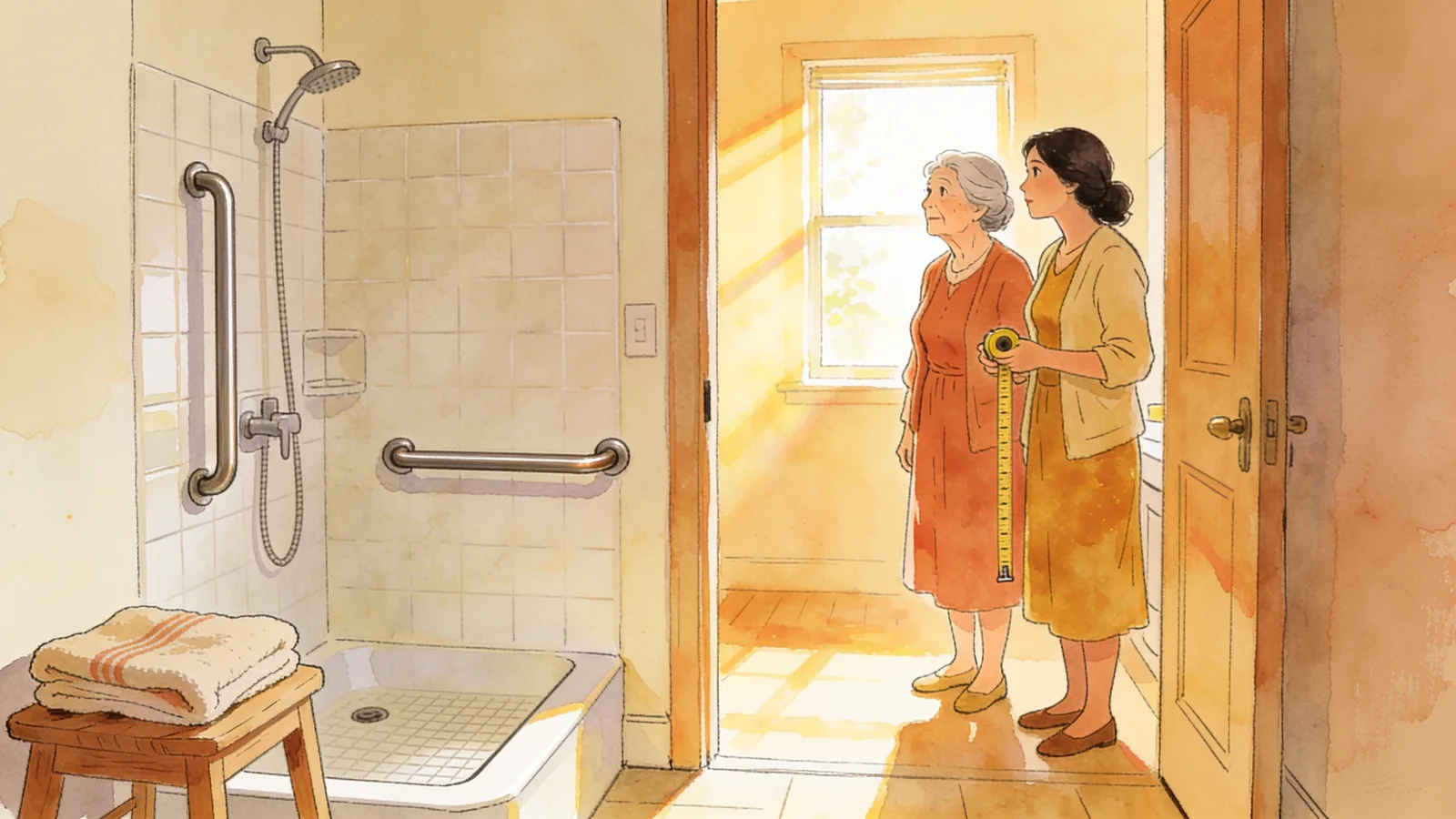
Short answer: Yes. ADA standards are a well-tested reference point. For example, the 2010 ADA Standards place grab bars 33 to 36 inches above the floor, measured to the top of the gripping surface. You can borrow guidance like that without treating it as a legal requirement for your house.
Think of the standards as a starting measurement, not a rulebook. The person who will use the grab bar matters more than the average public user. Height, reach, which hand is stronger, and how they actually get in and out of the shower should shape the final placement.
Grab bars also need to be anchored to solid support, and some wall work, plumbing or electrical changes need permits. That is where local building codes come in.
What about local building codes?
Short answer: Local building codes and permits still apply to home remodeling, whether or not the ADA does. Check with your local building department.
For a private home, the practical rule is simple: check with your local building department before structural, plumbing or electrical work. Permit requirements vary by place, so do not rely on a contractor's general statement, or on this article, for your address.
What does your house actually need?
Short answer: Start with the person and the room, not the rulebook. Figure out where daily routines get harder, which hazards are present, and which fixes matter most. Then get quotes for that short list.
The best time to look at the house is before anything goes wrong. Planning before something goes wrong is usually calmer and easier on everyone's dignity than a rushed remodel after a fall.
SeniorThrive's Room Safety Check isn't an ADA compliance check. It looks at the person and the room. It finds solutions that work for you, in your home and in your daily life. With a Room Safety Check, you take a photo of a room and get findings, a Home Safety Score and a short fix list. You walk into the contractor conversation knowing what the room needs, so the quote is built around your life instead of a commercial checklist.
FAQs
Do grab bars in my home have to be ADA compliant?
Generally no. In a privately owned single-family home, the ADA does not dictate grab bar placement. ADA guidance (33 to 36 inches above the floor, measured to the top of the gripping surface) is a helpful reference, and the bar must be securely anchored. Local codes apply to any related wall or plumbing work.
Does a walk-in or roll-in shower in my house need to meet ADA standards?
Not for a private home paid for privately. Shower design should fit the person using it. Plumbing and structural changes usually fall under local building codes, so check permit requirements with your local building department.
I rent. Can my landlord refuse to let me install grab bars?
Under the Fair Housing Act, a landlord generally cannot refuse reasonable modifications a tenant with a disability needs. The tenant usually pays, may have to restore the space at move-out, and may be asked to show the work will be done well with any required permits. In federally assisted housing, the provider may have to pay instead.
Do accessibility rules change if a government program pays for the work?
They can. Federally assisted programs fall under Section 504, and state and local government programs fall under ADA Title II. Each program sets its own requirements, so ask the program office which standards apply to your project.
Is ADA compliance a sign of better quality work?
Not necessarily. ADA standards were written for public spaces used by many people. At home, the better measure is whether a change fits the person who lives there, is installed securely and meets local code.
Sources
- U.S. Department of Justice, ADA Title III Technical Assistance Manual: https://www.ada.gov/resources/title-iii-manual/
- U.S. Department of Justice, ADA Title II overview: https://www.ada.gov/topics/title-ii/
- U.S. Access Board, ADA Accessibility Standards (2010), including Section 609.4: https://www.access-board.gov/ada/
- U.S. Access Board, Uniform Federal Accessibility Standards (UFAS): https://www.access-board.gov/aba/ufas.html
- HUD Section 504 regulations, 24 CFR 8.23 (alterations of existing housing): https://www.law.cornell.edu/cfr/text/24/8.23
- HUD Section 504 regulations, 24 CFR 8.32 (accessibility standards, UFAS): https://www.law.cornell.edu/cfr/text/24/8.32
- HUD, Deeming Notice permitting the 2010 ADA Standards with exceptions as an alternative to UFAS, 79 FR 29671 (May 23, 2014): https://www.federalregister.gov/documents/2014/05/23/2014-11844/nondiscrimination-on-the-basis-of-disability-in-federally-assisted-programs-and-activities
- HUD Section 504 regulations, 24 CFR 8.24 (existing housing programs): https://www.ecfr.gov/current/title-24/subtitle-A/part-8/subpart-C/section-8.24
- HUD Section 504 regulations, 24 CFR 8.33 (housing adjustments): https://www.ecfr.gov/current/title-24/subtitle-A/part-8/subpart-C/section-8.33
- HUD/DOJ Joint Statement, Accessibility (Design and Construction) Requirements for Covered Multifamily Dwellings Under the Fair Housing Act: https://www.justice.gov/crt/media/1457641/dl
- HUD Fair Housing regulation, 24 CFR 100.203 (reasonable modifications): https://www.ecfr.gov/current/title-24/subtitle-B/chapter-I/part-100/subpart-D/section-100.203
- HUD/DOJ Joint Statement on Reasonable Modifications (2008): https://www.hud.gov/sites/documents/reasonable_modifications_mar08.pdf
- USDA Rural Development, Single Family Housing Repair Loans & Grants (Section 504): https://www.rd.usda.gov/programs-services/single-family-housing-programs/single-family-housing-repair-loans-grants
This article is general information, not legal advice. Laws, codes and program rules vary by location and change over time. For your specific project, check with your local building department, the program funding your work, or a qualified attorney.