Most Clients Want Long-Term Care at Home. Few Have a Plan for the Home Itself.

When a client's plan says "stay at home," the physical home is either a funded line item or an unhedged risk. Advisors close that gap by putting the house in the plan: what needs fixing, who in the family knows, and when to act.
Your client is 71. Her portfolio is disciplined. Her trust is funded. Her long-term care directive, repeated every review, is simple: "I am staying in this house."
You believe her. But nobody has asked whether the house agrees.
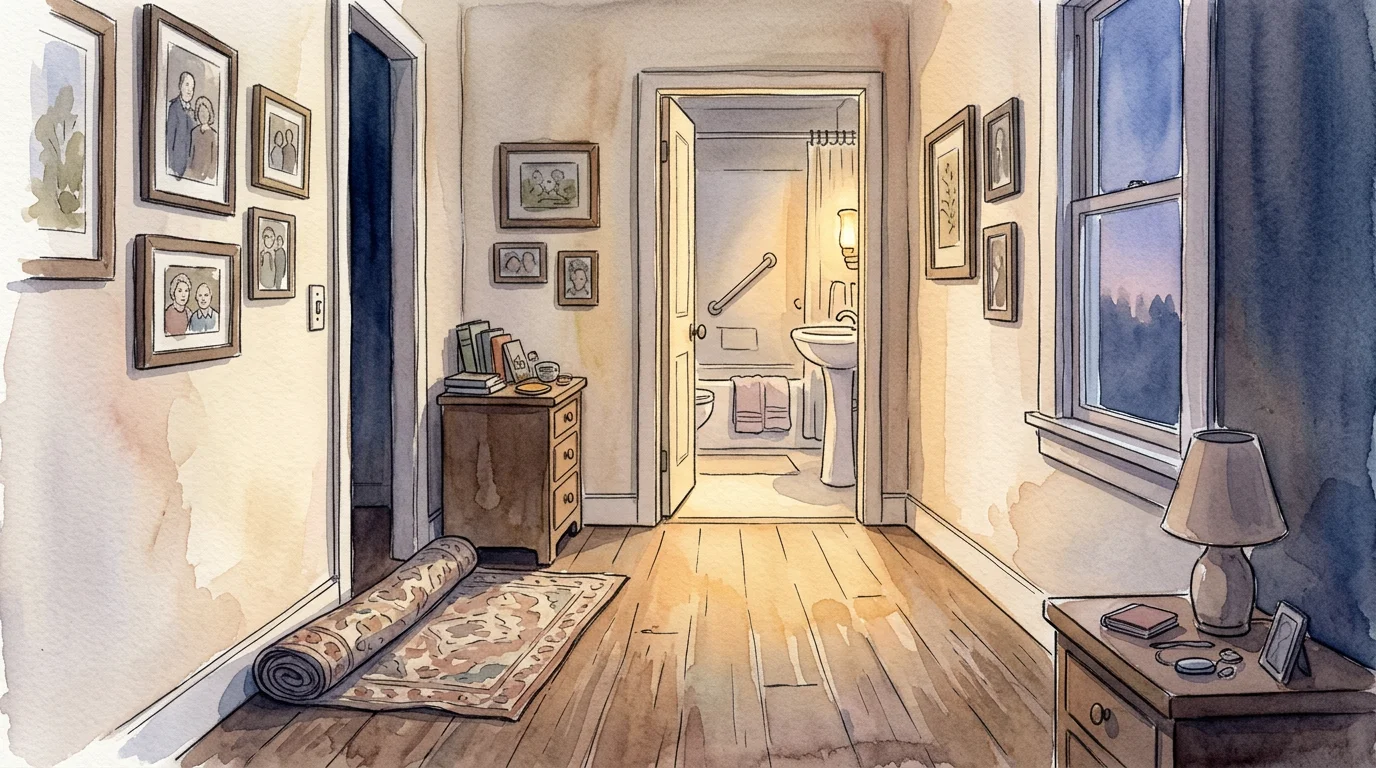
The narrow staircase to the only full shower. The sunken living room step. The tub she must climb over. The son in Denver who has never seen the property layout or discussed care logistics.
Every comprehensive wealth plan makes an assumption about where care will happen. When that assumption is "at home," the house itself is either a funded line item or an unhedged operational risk.
Why this matters now: the 2026 data gap
A new national study puts numbers on what advisors hear in every review. People want care at home, they expect to need it, and most have not planned for it. Clients with an advisor are about twice as likely to have a plan.
Northwestern Mutual's 2026 Planning & Progress Study (released October 5, 2026) shows a clear gap between intention and readiness (Northwestern Mutual):
- The home preference: 73% of Americans would prefer in-home care if a health event required long-term support. That rises to 83% of Boomers and older.
- The reality: 61% say they are likely to need long-term care, and 56% expect to provide it for someone they love.
- The planning void: 54% have not planned financially for their own long-term care, and 60% have not planned for caring for a loved one.
- The advisor advantage: People who work with a financial advisor are far more likely to have a plan: 66% versus 34% for their own care, and 58% versus 29% for a loved one.
- The hidden strain: Among current and former caregivers, 25% have drawn from savings or emergency funds and 21% have worked longer hours or taken a second job to absorb the cost. Advisors can quantify what family caregiving time is worth before that strain hits.
One baseline fact clients often miss: Medicare does not pay for long-term care when that is the only care someone needs (Medicare.gov).
The house is a line item in longevity planning
A home-care preference is only as durable as the floor plan behind it. A bathroom without a grab bar or a bedroom up a flight of stairs can turn "I'm staying here" into an urgent decision the family never planned for.
| Plan Component | Managed By | What Is Typically Missing |
|---|---|---|
| Retirement income and capital preservation | Financial advisor | Usually complete and modeled |
| Long-term care funding | Advisor, insurance, or self-funding | Clarity on where that daily capital is deployed |
| Legal directives and powers of attorney | Estate planner or elder law attorney | Family knowing where original signed copies live |
| The physical residence | Usually unassigned | Room modification costs and accessibility friction |
| Family operational roles | Usually unspoken | Who is the primary local contact, and the protocol when siblings disagree |
Home modifications are rarely prohibitive when anticipated early: zero-threshold entries, widened paths of travel, better lighting on stairs, or moving daily living to the ground floor.
What turns modifications into a financial shock is doing them under a 72-hour hospital discharge deadline. Handled early, they are a minor capital expense. Handled late, they trigger forced liquidations and emotional triage.
Three discovery questions for your next review
Advisors do not need to become contractors or occupational therapists. Your role is asking the clarifying questions that make the physical residence visible.
- "If mobility became limited for six months, which room in your home would present the steepest challenge?" Why it works: it shifts the discussion from an abstract future to a physical door sill or shower lip.
- "If you needed home support tomorrow, who in the family coordinates it, and have they seen this roadmap?" Why it works: most families assume an adult child will step in, but have never formalized the expectation. Bringing this up keeps your firm in the middle of the intergenerational conversation.
- "If your preference is receiving care at home, have we factored physical home modifications into your retirement reserve?" Why it works: it normalizes home safety adaptations as a routine balance-sheet allocation rather than an admission of frailty.
How SeniorThrive fits your wealth advisory workflow
SeniorThrive bridges portfolio modeling and physical reality. It gives the household a room-by-room plan for the house without asking your team to inspect the property.
- Physical assessment. The client or family takes photos of key rooms. A Room Safety Check returns findings and a Home Safety Score, with a short list of practical fixes that belong to that check. Those findings give you a clearer picture of home readiness to discuss in a review. They are not verified contractor bids or cash-flow model inputs.
- Family alignment. Planning Ahead helps the household organize questions for the next review. The Conversation Guide helps clients open dialogue with adult children before a crisis.
- Next-generation goodwill. Through Privacy & Sharing, clients can grant view permissions to adult children. You build goodwill with the next generation around an active plan long before an inheritance event.
- Client-first privacy. Clients own their data. We do not sell it. Clients decide who sees it, and nothing watches them. Advisors and family participate only by invitation into their Circle.
- Clear professional boundaries. The Home Safety Score assesses physical room conditions. It is not an actuarial, medical, or underwriting warranty. SeniorThrive does not provide investment, legal, or tax advice. It gives you environmental context so your advice stays grounded in the house the client actually lives in.
Next steps for your firm: Review how advisors use this in quarterly check-ins at SeniorThrive for financial advisors, or see what your client gets. If you coordinate with counsel, see SeniorThrive for elder law attorneys. To receive family referrals in your market, join the Professional Network.
Frequently asked questions
Does Medicare pay for long-term care at home?
Medicare does not pay for non-skilled custodial care (such as help with bathing, dressing, eating, or transfers) when that is the only care required. Custodial care at home is typically self-funded through personal savings, long-term care insurance, or Medicaid for people who qualify.
How should a financial advisor start a long-term care conversation?
Begin with personal autonomy rather than costs: ask where the client envisions living, which rooms would present hurdles after a routine joint surgery, and who in the family holds operational responsibility. Grounding the conversation in the physical home makes insurance and liquidity decisions concrete.
What home modification costs should a retirement plan account for?
Common home adaptations include grab bars, non-slip surfaces, threshold transitions, better lighting along transit corridors, and sometimes a stairlift or first-floor suite conversion. These range from several hundred dollars for hardware to about $10,000 to $30,000 for larger renovations. Exact costs depend on the house and local labor.
Can our advisory team access client reports directly?
Only if the client adds you to their Circle. Access is controlled by the account owner, so privacy stays intact while collaborative planning remains possible.
What does SeniorThrive cost the client?
A family member starts free with no credit card. The 14-day free trial starts when the older adult joins. After that, the Emergency Card and past Room Safety Check reports stay free. New Room Safety Checks, Planning Ahead, and family sharing are part of Essential at $29 a month for the older adult and one family member. My Daily Check-In stays free.
Is SeniorThrive an aging in place tool?
While many families start by searching for aging in place solutions, the true goal is thriving at home on your own terms. SeniorThrive is a plan for living well at home: room safety, family coordination, and daily stability so clients stay in control of their surroundings.
Sources
- Northwestern Mutual, 2026 Planning & Progress Study, released Oct 5, 2026. https://news.northwesternmutual.com/2026-10-05-More-Than-80-of-Boomers-Want-to-Age-at-Home-Are-Families-Ready-for-the-Financial,-Physical-and-Emotional-Costs
- Medicare.gov, Long-Term Care. https://www.medicare.gov/coverage/long-term-care