Before Guardianship: When the Worry Is the House, Not Her Judgment
When a family asks about guardianship because a parent seems unsafe at home, the trigger is often the house: a dark stair, a slick tub, nobody knowing she fell. Fix what the house is doing first. It is a less restrictive alternative, and she keeps her rights.
Picture the call. A daughter, two states away, on her lunch break: "Mom fell on the basement stairs again. She won't hear about moving. Do we need to get guardianship?"
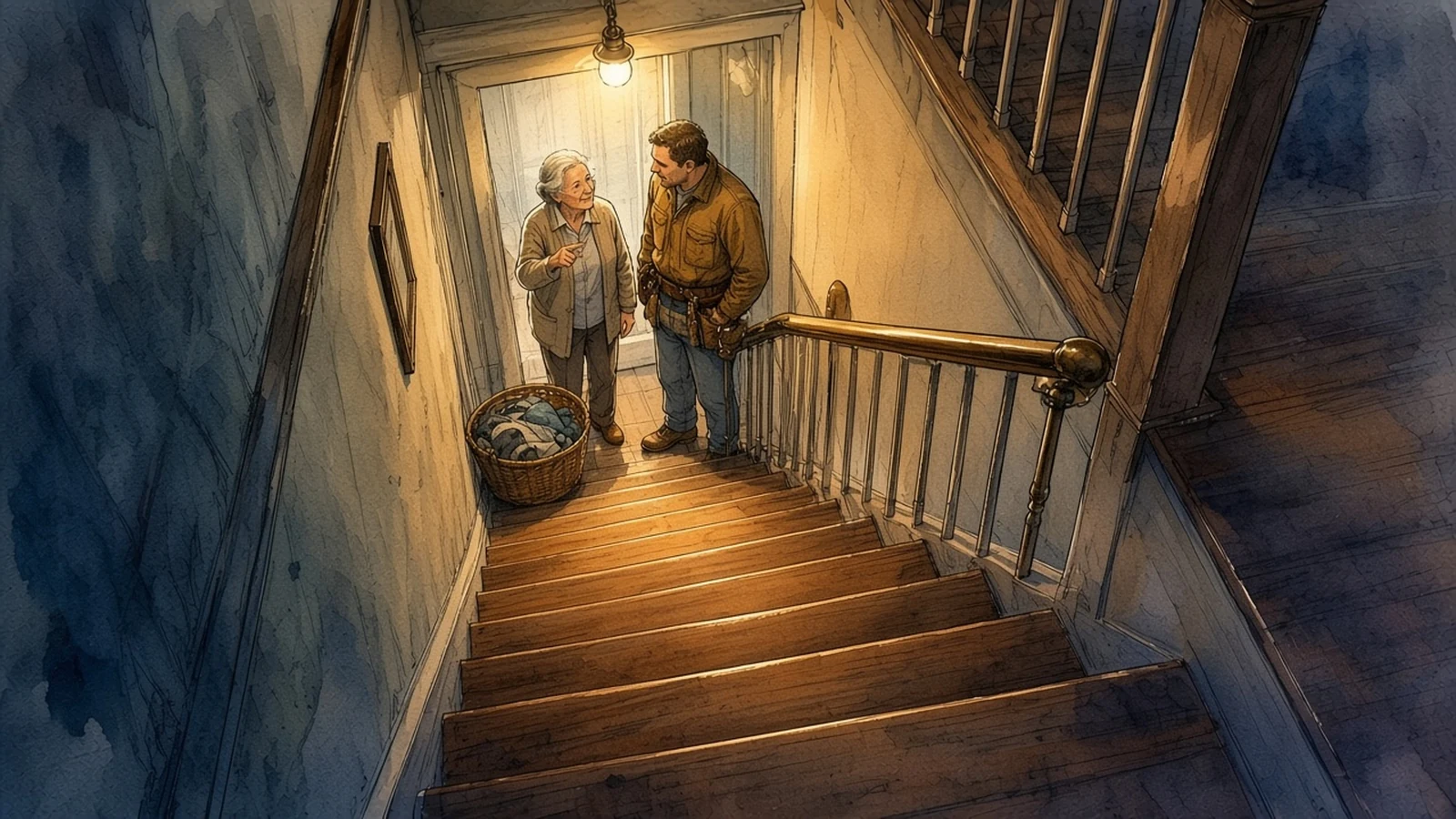
Her mother is 82. She balances her own checkbook, reads two newspapers and has opinions about both. She also has a basement staircase with one rail, a 40-watt bulb and a laundry basket she carries in both hands. Nothing in that picture says she cannot make her own decisions. Plenty of it says the staircase is making them for her.
Why this question lands on your desk
Families reach for guardianship because it sounds like safety. Federal research and the ABA's own lawyer tool both say to look at less restrictive options first, and home safety concerns are often the easiest to answer without a court.
The National Council on Disability's report Beyond Guardianship (2018) estimates that about 1.3 million people in the United States are subject to guardianship. It found that guardianship is often imposed when the facts do not warrant it, and that although most state laws require courts to consider less restrictive alternatives, courts do little to enforce that requirement.
That puts the weight on the lawyer in the first conversation. And the first conversation, more often than families admit, is about the house. AARP's 2024 Home and Community Preferences survey found that 75% of adults 50 and older want to stay in their current home for as long as possible. When the house starts to feel dangerous, the family's fear and her wish collide, and guardianship can look like the only way to break the tie.
What the PRACTICAL tool says about the home
The ABA PRACTICAL Tool names the home in two of its nine steps: living independently and maintaining habitable conditions as reasons for concern, and home modifications and assistive technology as accommodations that may meet the need.
PRACTICAL is a joint product of four American Bar Association entities, including the Commission on Law and Aging, with help from the National Resource Center for Supported Decision-Making. It is a checklist of nine steps for lawyers to use during and right after the client interview:
- Presume guardianship is not needed.
- Reason. Clearly identify the reasons for concern. Its list includes "Community Living: living independently, maintaining habitable conditions."
- Ask if a triggering concern may be caused by temporary or reversible conditions, including medication side effects and hearing or vision loss.
- Community. Determine whether family or community resources and accommodations can address the concern. Its list includes in-home care and home-delivered meals, and under accommodations, "assistive technology" and "home modifications."
- Team. Ask whether the person already has a team of friends, family or professionals to help.
- Identify abilities.
- Challenges. Screen for problems with the proposed supports.
- Appoint a legal supporter or surrogate consistent with the person's values and preferences.
- Limit any necessary guardianship petition and order.
Read steps 2 and 4 together and a pattern appears. If the reason for concern is a fall on the stairs, the first accommodation to test is the stairs.
When the worry is the house: a working table
Separate what the family fears from what is actually happening, then match each one to the least restrictive answer and the person who provides it. Many intake worries resolve to a repair, a routine or a signed document you draft.
| What the family says | What is often happening | Less restrictive response | Who handles it |
|---|---|---|---|
| "She keeps falling." | Dim stairs, one rail, a slick tub, rugs | Lighting, a second rail, grab bars; an occupational therapy home evaluation | Her, family, a contractor, an OT; her doctor for medical causes |
| "Nobody would know if she fell." | She lives alone and nobody checks in on a schedule | A daily check-in she does herself, with people she chooses | Her and the people she picks |
| "Paramedics wouldn't know her medicines." | Nothing written down where responders look | An emergency sheet on the fridge and her phone | Her, with family |
| "We can't find her papers." | Documents exist but nobody knows where | A record of where each signed original is kept | Her, with counsel |
| "She can't handle this alone anymore." | She needs help with some tasks, not all decisions | Durable powers of attorney, a health care agent, supported decision-making where state law allows | You |
The last row is your work, and no app replaces it. The first four rows are where families often stall, and where a little structure at home can take the urgency out of the call.
How to use this at intake
Walk PRACTICAL with the house in mind. Ask for the specific incident, ask for the room, ask what changed, and ask who already helps. Then decide what, if anything, needs a court.
- Get the incident, not the conclusion. "She's not safe" is a conclusion. "She fell on the third basement step carrying laundry at night" is a fact you can work with.
- Ask which room. Then ask whether anyone has looked at that room since. Blame the house, not the person. When the fix is a bulb and a rail, the capacity question often answers itself.
- Look for reversible causes. PRACTICAL's step 3 lists medication side effects and sensory loss. A conversation with her doctor may matter more than any filing.
- Name the team she already has. The daughter on the phone, the neighbor with a key, the son who handles the gutters. A team that knows its jobs is a support, not a substitute for her judgment.
- Draft what needs drafting. A durable power of attorney and a health care agent, signed while she can sign them, are the classic alternatives. That is legal work, and it stays with you.
If the family is stuck on whether she should move at all, our pieces on when family thinks she should move and when siblings disagree are written for them. Our earlier post for estate planners, the trust says stay home, covers putting the house in the plan.
Where SeniorThrive fits
SeniorThrive gives your client a plan for the home that she runs herself, with the people she chooses. It can cover the first four rows of the table so the family arrives calmer and your meeting starts with the law.
What your client gets, in the words of our live SeniorThrive for elder law attorneys page and feature pages:
- Room Safety Check. She photographs a room. SeniorThrive reads the photos and shows what deserves attention: a short list of fixes. It talks about floors, lights and rails, and its score is about the house, never about her. A family member can try a free preview Room Safety Check of their own home. It shows on screen and is not saved. Saved Room Safety Checks of her home are part of Essential. For a clinical home evaluation, the app points her to an occupational therapist, and our occupational therapist directory lists approved OTs in the SeniorThrive network. It is small and growing, so readers can also search AOTA's Find an OT. Home Repair Help points to programs that can help pay for repairs.
- My Daily Check-In, free, and Morning Peace of Mind: she picks a time and who in her Circle in SeniorThrive to tell. If she has not checked in by then, the people she picked get a gentle note in the app. It is part of every plan, including Free. She can see who is in her Circle and remove anyone at any time.
- Emergency Card, free. Her conditions, medicines and who to call, on her phone and printed for the fridge.
- My Documents. Power of Attorney sits under "Someone to Handle My Affairs". For each paper she keeps on paper, it asks "Where is the original kept?" SeniorThrive drafts no legal documents. That stays with you.
None of this is a capacity assessment. She stays the author of her own life. That is the point.
One line for the intake packet
The best moment to share is when you send the intake packet. One link gives the family something useful to do before the first meeting.
Try: "Before we meet, ask your mother to start with the room where she fell. Bring what you find, and we will talk about what actually needs a legal answer."
See what your client gets, and join the Professional Network, free for attorneys, so families who need an elder law attorney can find you.
Brian Fluhr, Founder, SeniorThrive
Frequently asked questions
What are alternatives to guardianship for an older parent?
Common less restrictive options include a durable power of attorney, a health care agent or advance directive, a trust, supported decision-making where state law allows, and practical supports at home. An elder law attorney can say which fit her and her state.
Do courts have to consider less restrictive alternatives?
Most state laws require it, according to the National Council on Disability's 2018 report Beyond Guardianship. The same report found that courts often do little to enforce that requirement, so the first conversation with counsel matters.
What is the ABA PRACTICAL Tool?
It is a nine-step checklist from four American Bar Association entities that helps lawyers find decision-making options less restrictive than guardianship. It lists home modifications and assistive technology among the accommodations that may address a concern.
Can home safety changes help avoid guardianship?
Sometimes. When the worry is falls or an unsafe room, fixing the house is one less restrictive response the PRACTICAL Tool names. It does not settle legal questions, and an attorney should review the full situation.
Is safety at home a reason to seek guardianship?
Not on its own. The PRACTICAL Tool asks lawyers to identify the specific reason for concern, check whether it is temporary or reversible, and test community supports and accommodations, such as home modifications, before considering a limited petition.
How does SeniorThrive work with elder law attorneys?
Your client keeps a plan for her home, an Emergency Card and a record of where her signed papers are kept. SeniorThrive drafts no legal documents. The Professional Network is free for attorneys to join.
Sources
- National Council on Disability, Beyond Guardianship: Toward Alternatives That Promote Greater Self-Determination for People with Disabilities (March 22, 2018). https://www.ncd.gov/report/beyond-guardianship-toward-alternatives-that-promote-greater-self-determination-for-people-with-disabilities/
- American Bar Association, PRACTICAL Tool (Commission on Law and Aging and partners). https://www.americanbar.org/groups/law_aging/resources/guardianship_law_practice/practical_tool/
- PRACTICAL Tool for Lawyers: Steps in Supporting Decision-Making (tool text, copy hosted by the Delaware courts). https://courts.delaware.gov/forms/download.aspx?id=162428
- AARP, 2024 Home and Community Preferences Among Adults 18 and Older. https://www.aarp.org/content/dam/aarp/research/topics/livable-communities/housing/2024-home-community-preferences-report.doi.10.26419-2fres.00831.001.pdf
This article is general information for professionals and families, not legal advice. SeniorThrive is not affiliated with or endorsed by the American Bar Association, the National Council on Disability, AARP or any organization named here. A Room Safety Check describes the house. It is not a medical device, a home inspection, a clinical assessment or a capacity assessment.