How to Support Sandwich-Generation Employees Caring for Aging Parents

Support sandwich-generation employees by covering every stage of a parent's life at home, not only the crisis. Give them time they can use without asking twice, keep your EAP, add care navigation or backup care for active care, and add a benefit that helps at the parent's home before care is needed. That early stage is where most of your people are, and it is where strain is cheapest to stop.
By Brian Fluhr
The person this is about
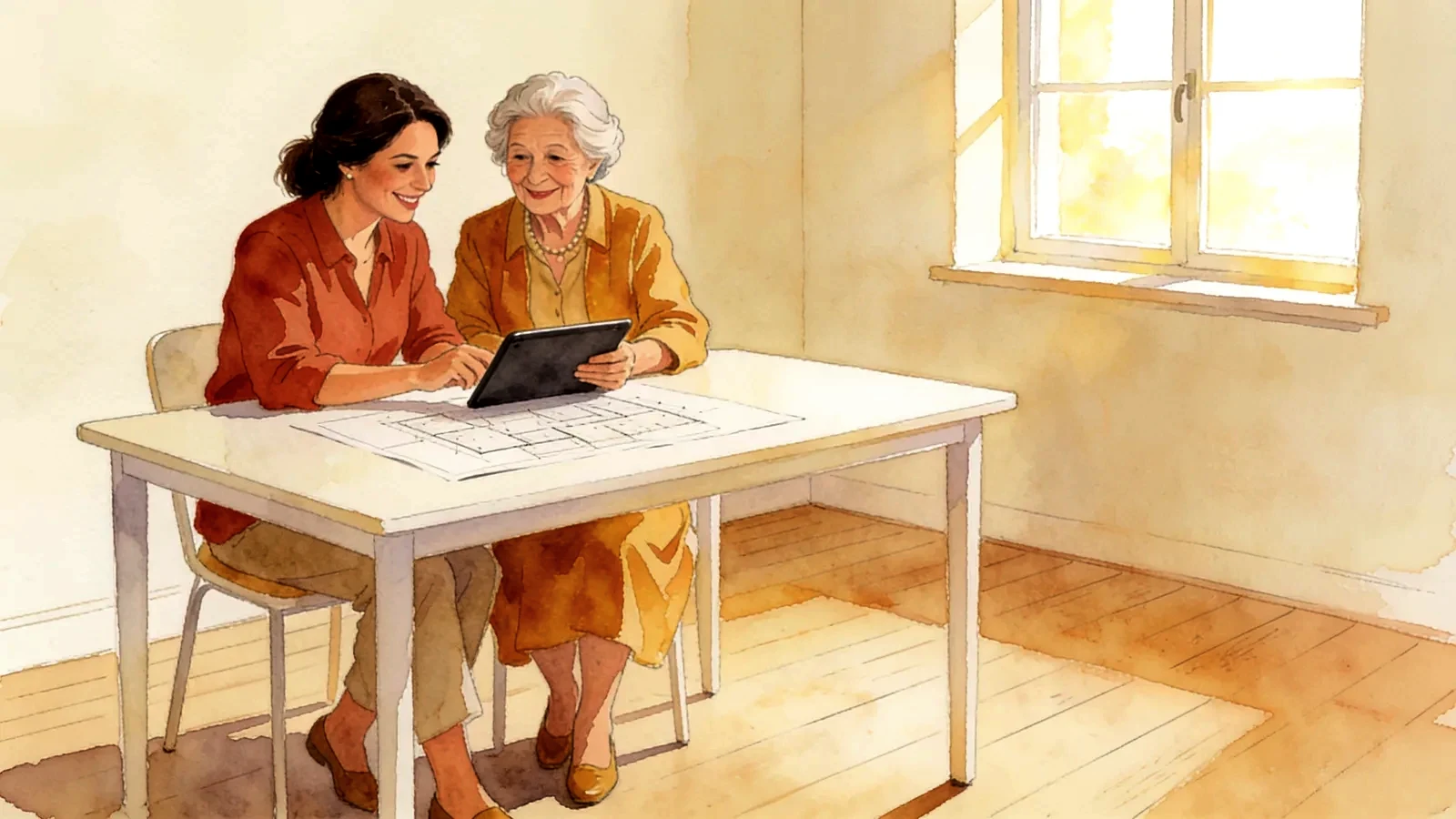
Picture a second-shift supervisor at your largest plant. She is 46. One child is in middle school and another is in college on her paycheck. Her father is 78, lives alone forty minutes away, and wants to stay in the house he has lived in for decades.
She is not in a crisis. She calls him on her break. She texts her brother about the gutters. She drives over on Saturday mornings and quietly looks at the stairs. She has not told her manager, and nothing she is doing triggers a benefit you offer today. Because she works a shift, even the lunch-hour phone call her salaried peers make is harder for her to fit in.
If you run HR for a 2,000-person company, you have a lot of her. This guide is about what to do for her this quarter, and how to tell which caregiver benefits will actually reach her.
This is the hub for our series on The Employer Caregiver Crisis. Links to every post are at the end.
How many of your people are sandwiched
- 25% of U.S. adults have a parent 65 or older and also have a child under 18 or gave financial help to an adult child in the past year. That rises to 54% of adults in their 40s and 45% of adults in their 50s, up from 36% for people in their 50s in 2021 (Pew Research Center).
- Nearly 1 in 3 family caregivers is also raising a child under 18 while caring for an adult. Among caregivers under 50, it is 47% (AARP and National Alliance for Caregiving, Caregiving in the US 2025).
- 63 million Americans are family caregivers, and six in 10 of them are employed (same source).
- One in five employees is a caregiver (Integrated Benefits Institute, The Working Caregiver).
Look at the ages. The people most likely to be sandwiched are in their 40s and 50s: your experienced supervisors, senior technicians and middle managers. They are the hardest people to replace.
What it costs before anyone files for leave
The National Alliance for Caregiving and AARP asked working caregivers what caregiving does to their work (Caregiving in the US 2025: Working While Caregiving):
- 49% go in late, leave early or take time off during the day to provide care.
- 18% went from full-time to part-time or reduced hours because of caregiving.
- 31% have used up their short-term savings.
- Only 49% say their supervisor knows about their caregiving.
Half of the cost never shows up in your attendance data. We put dollar figures on that hidden loss in how much productivity employers lose when employees care for an aging parent.
The finding that should change how you buy
In January 2026 the Integrated Benefits Institute published research on working caregivers. Compared with employees under no caregiving strain, the odds of productivity loss were 4 times higher at low strain, 10 times higher at moderate strain and 40 times higher at high strain. IBI's conclusion: "Preventing progression from low to moderate strain provides the greatest opportunity for protecting workplace productivity" (IBI).
Read that twice. The biggest return is not in the crisis. It is in keeping a manageable situation manageable. That is exactly where your supervisor is today: her father is fine, the house is old, and the plan lives in her head.
The National Institute on Aging says the same thing from the family's side. When a family sits down to decide who does what, "this conversation will be most productive when there is not an emergency" (NIA, The Caregiver's Handbook).
Most caregiver benefits switch on when the need is obvious: a diagnosis, a discharge, a search for in-home help. That work matters. But it leaves the low-strain stage, the one IBI says pays back most, with little more than an EAP phone number.
The hourly gap
The same NAC report found that salaried workers get better caregiving benefits than hourly workers. Across all working caregivers, 61% have access to flexible hours, 39% to paid family leave and 37% to telecommuting or remote work (NAC and AARP).
If your workforce runs on shifts, a benefit that only works through a 45-minute call with a coordinator at 11 a.m. will not reach the floor. Ask whether a benefit works on a phone, on a Saturday, without anyone in HR in the middle.
Map your benefits to the stage the parent is in
| Stage | What it looks like | What the employee needs | What usually covers it |
|---|---|---|---|
| Before care | Parent lives independently at home. Employee checks in, worries about the house, carries the plan alone. | A clear look at the home, the essentials written down, the family on one plan. | Often nothing. A home-focused benefit fits here. |
| Active care | A diagnosis or a change that needs more help. | Research, paperwork, options, a care plan. | Care navigation, such as Wellthy (which announced it acquired Cleo on Sept 14, 2026), Cariloop and Homethrive. |
| Crisis day | A fall, a hospital stay, a caregiver who does not show up. | Time off, short-notice care, information fast. | Leave policy and backup care, such as Bright Horizons and Care.com. Some navigation vendors now include backup care too. |
| Every stage | The employee's own stress. | Someone to talk to. | Your EAP. Keep it. |
Put every benefit you offer into one of those rows. If the "Before care" row is empty, you have found the gap. We compare the EAP and the major caregiver benefits side by side in why EAPs fall short on elder care, and we lay out the full benefits stack in what caregiver support benefits HR should offer.
What "in-home support" should actually mean
Plenty of vendors list in-home support. Ask what it means in practice. For the before-care stage, a real in-home benefit does five things:
- Looks at the actual house, room by room, and returns a short list of fixes ranked by what matters most. Not a pamphlet.
- Puts the essentials in one place: the people to call, conditions, medications and allergies, on the phone and on the fridge.
- Offers a quiet daily check-in that the parent chooses. Morning Peace of Mind is optional: the parent turns it on, picks who hears, and can pause it with Vacation Mode or switch it off. Not a camera.
- Puts the family on one plan, so your employee stops being the family switchboard.
- Keeps the parent in charge. The parent is invited, not enrolled, and decides what is shared.
Why start with the house? Falls are the leading cause of injury for adults 65 and older. Over 14 million, about 1 in 4, report a fall every year, and the age-adjusted fall death rate rose 21% from 2018 to 2024 (CDC Older Adult Falls Data).
Most homes were not built for a slick tub, a low sofa or a 2 a.m. walk to the bathroom. A step down into the living room is a feature of the house, not a failure of the person who lives there. Blame the house, not the person. Fixing a rail or a light is cheap. A week of emergency leave is not. We walk through what to do on the day itself in how employers can reduce emergency leave when a parent has a crisis.
Seven questions to put to every vendor on your shortlist
- Which stage does it serve? Before care, active care, crisis, or all three. Make the vendor say.
- Does anything reach the parent's home? Not a referral list. The house itself.
- Does the parent join by invitation and decide what is shared? A parent is running their own life. A benefit that treats them as a case will not get used.
- Can siblings and spouses work from the same plan? If not, the coordination stays on your employee's desk.
- Does it work for hourly and shift workers? On a phone, on a weekend, without an HR intermediary.
- What will you report to us? You want counts you can act on, never a person's name or a household.
- What does launch take? An eligibility file, an IT integration, weeks to go live, a launch kit, manager talking points.
Managers matter more than most launch plans admit. Only 29% of employers rate their managers as very prepared to support caregiving challenges (Care.com 2026 Future of Benefits Report).
Where SeniorThrive fits
SeniorThrive is built for the before-care stage. It sits beside your EAP and any care navigation you have. It does not replace them.
- Room Safety Check. The employee or the parent photographs a room. SeniorThrive returns a ranked fix list and a Home Safety Score the same day. It talks about floors, lights and rails, and its score is about the house, never about the person. (What a Room Safety Check is.)
- Emergency Card. Conditions, medications and the people to call, on the phone and on a printable page for the fridge. Free.
- My Daily Check-In. A short check-in, under a minute: how she is feeling today and a one-tap question about slips. Free. The check-in is hers to choose. Morning Peace of Mind is optional: she turns it on, picks who hears, and can pause it with Vacation Mode or switch it off. With Morning Peace of Mind, if she has not checked in by the time she chose, the people she picked get a gentle note. It is part of every plan, including Free.
- Circle in SeniorThrive. The plan covers 4 people, the parent plus up to 3 family members, the employee included. Each parent joins only by invitation.
For HR, the details are on SeniorThrive for Employers: employees enroll with a work email or an employer code, with no eligibility file. It launches three weeks after you sign and sits outside the group health plan. You get a one-page, counts-only report each month, and any count under 5 shows as "Fewer than 5."
If you are a broker: SeniorThrive is software, not insurance. You get a 30-minute briefing, a co-branded client webinar, the launch kit, and me on the line for any client conversation.
A 30-day plan
Week 1: Count. Add one question to your next pulse survey: "Do you help an older parent or relative, even a little?" Skip the word "caregiver." Only 37% of employees identify as caregivers, even though many more are providing care (Care.com).
Week 2: Map. Put every benefit you offer into the stage table above. Circle the empty rows.
Week 3: Brief managers. Give them three sentences: what the benefits are, which stage each one serves, and where to point someone who mentions a parent. The first time an employee brings up a parent is the moment that matters.
Week 4: Shortlist. Send the seven questions to each vendor. Ask every one for its launch kit and a sample report.
The Employer Caregiver Crisis: the series
- Why EAPs fall short on elder care, and how to compare caregiver benefits
- What caregiver support benefits HR should offer employees caring for aging parents
- How much productivity employers lose when employees care for an aging parent
- How employers can reduce emergency leave when an employee's parent has a crisis
The short version
Your supervisor's father wants to stay in his house. She wants that too. The cheapest moment to help both of them is now, while it is still a Saturday-morning worry and not a Tuesday-morning phone call.
See how SeniorThrive works for employers, or book 20 minutes with me there.
Frequently asked questions
What is the sandwich generation at work? Employees who have a parent 65 or older and also have a child under 18 or support an adult child. Pew Research Center puts it at 25% of U.S. adults and 54% of adults in their 40s, which means many of your mid-career managers and senior staff.
What are the best caregiver benefits for employers? There is no single best benefit. Match benefits to stages: flexible time and leave, an EAP for the employee, care navigation or backup care for active care, and a home-focused benefit for the long stretch before care is needed. Most employers already cover the first two and leave the before-care stage empty.
How can HR support employees caring for aging parents? Count them with a plain survey question, map current benefits to the stage the parent is in, brief managers on where to point people, and fill the before-care gap. Research from the Integrated Benefits Institute finds the biggest payoff comes from keeping low caregiving strain from becoming moderate strain.
Is an EAP enough for sandwich-generation employees? An EAP helps the employee with counseling and referrals, and it is worth keeping. It does not reach the parent's home or put the family on one plan, so it works best alongside care navigation, backup care and a home-focused benefit.
What should in-home support include in a caregiving benefit? A room-by-room look at the actual house with a ranked fix list, the essentials in one place, a daily check-in the parent chooses, one plan for the whole family, and the parent in charge of what is shared.
Does SeniorThrive replace care navigation or backup care? No. SeniorThrive covers the stage before care is needed: the home, the essentials and the family plan. It sits beside an EAP, care navigation and backup care.
Sources
All fetched 2026-11-03.
- Pew Research Center, "More than half of Americans in their 40s are sandwiched between an aging parent and their own children" (updated Aug 27, 2026; survey of U.S. adults, Sept. 2025): https://www.pewresearch.org/short-reads/2022/04/08/more-than-half-of-americans-in-their-40s-are-sandwiched-between-an-aging-parent-and-their-own-children/
- AARP and National Alliance for Caregiving, Caregiving in the US 2025 (press release, July 24, 2025): https://www.aarp.org/press/releases/2025-07-24-new-report-reveals-crisis-point-for-americas-63-million-family-caregivers.html
- National Alliance for Caregiving and AARP, Caregiving in the US 2025: Working While Caregiving: https://www.caregivingintheus.org/wp-content/uploads/2025/12/NAC_CGUS25_Working-While-Caregiving.pdf
- Integrated Benefits Institute, Infographic: The Working Caregiver: https://www.ibiweb.org/resources/infographic
- National Institute on Aging, The Caregiver's Handbook: https://order.nia.nih.gov/sites/default/files/2023-03/caregivers-handbook-nia_0.pdf
- CDC, Older Adult Falls Data (updated Sept. 4, 2026): https://www.cdc.gov/falls/data-research/index.html
- Care.com, 2026 Future of Benefits Report (press release): https://www.care.com/about/press/new-care-com-research-reveals-a-critical-visibility-gap-in-a-modern-workforce-that-runs-on-caregiving/
- Wellthy, "Wellthy Acquires Cleo as Two Leaders Come Together to Create the Singular Platform for Family Care," GlobeNewswire (Sept. 14, 2026): https://www.globenewswire.com/news-release/2026/09/14/3361281/0/en/wellthy-acquires-cleo-as-two-leaders-come-together-to-create-the-singular-platform-for-family-care.html