Stair Fall Hazards: Dual Railings, Contrast Strips, and Stair Lifts
While bathrooms claim the highest total volume of in-home falls, staircases produce the most severe and fatal injuries. Falling down even three steps generates enough gravitational acceleration to cause traumatic brain injuries, cervical spine fractures, and permanent mobility loss.
Yet stair safety is frequently reduced to a binary choice: either pay $4,000 to $12,000 for a motorized stair lift, or move to a single-story home. In clinical reality, more than 80% of stair hazards can be remediated with proper handrail geometry, step-edge visual contrast, and automated illumination.
Under the Home Safety Score methodology, staircases have a zero-tolerance margin: missing handrails and dark landings trigger instant Critical deductions. Below is the clinical breakdown of stair and hallway hazards, how to score them, and the exact specifications required to make stairs safe.
The 6 Stair & Hallway Hazards Ranked by Severity
| Hazard Finding | Severity Tier | Safety Score Deduction | Standard Clinical Fix | Estimated Cost |
|---|---|---|---|---|
| 1. Single Handrail (Missing Dual Support) | Critical | -25 Points | Install second continuous handrail along opposite wall, anchored into wall studs | $180 – $350 |
| 2. Handrail Abrupt Termination | Critical | -25 Points | Extend handrails 12 inches past top and bottom risers, returned smoothly to wall | $80 – $150 |
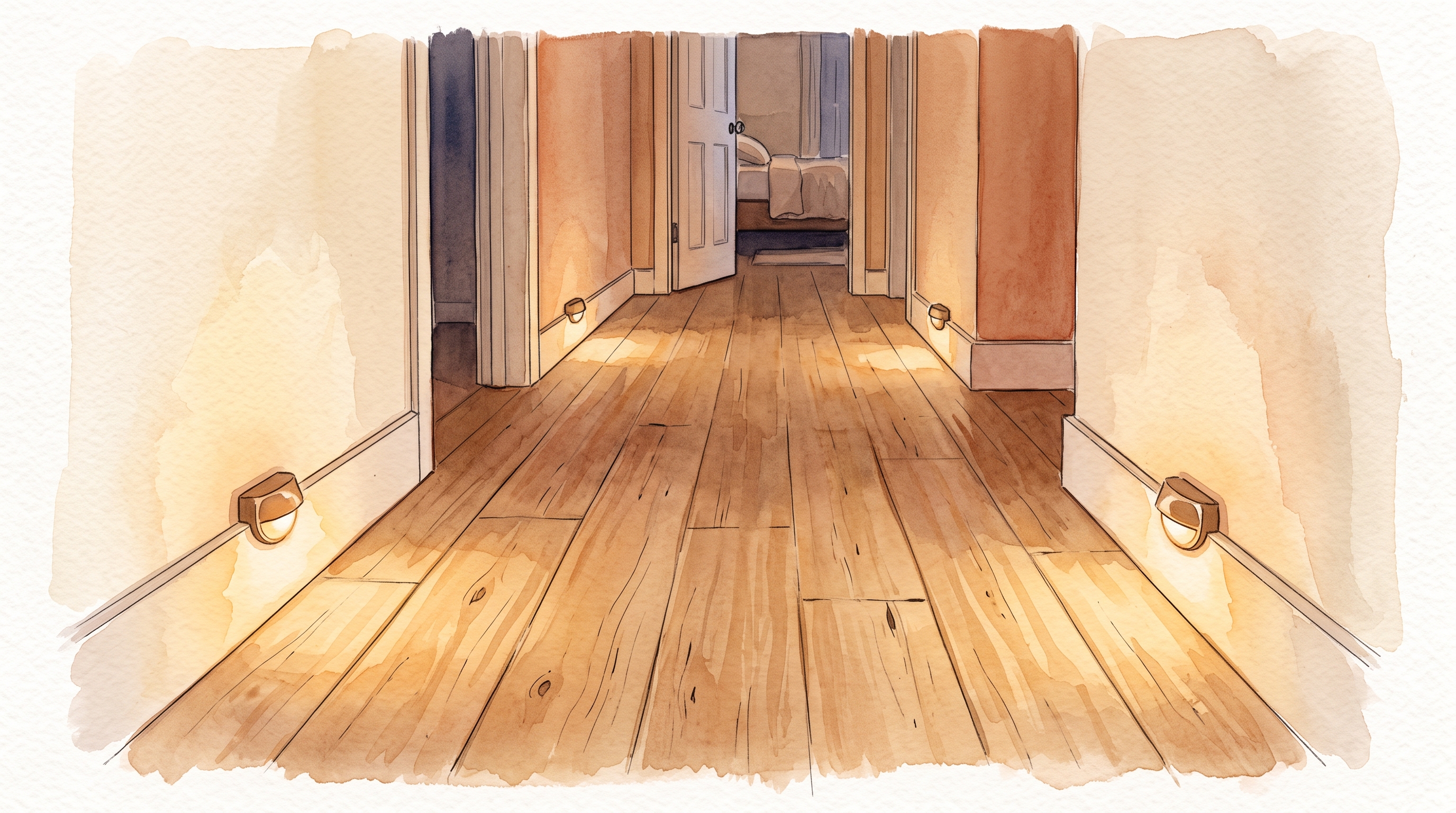
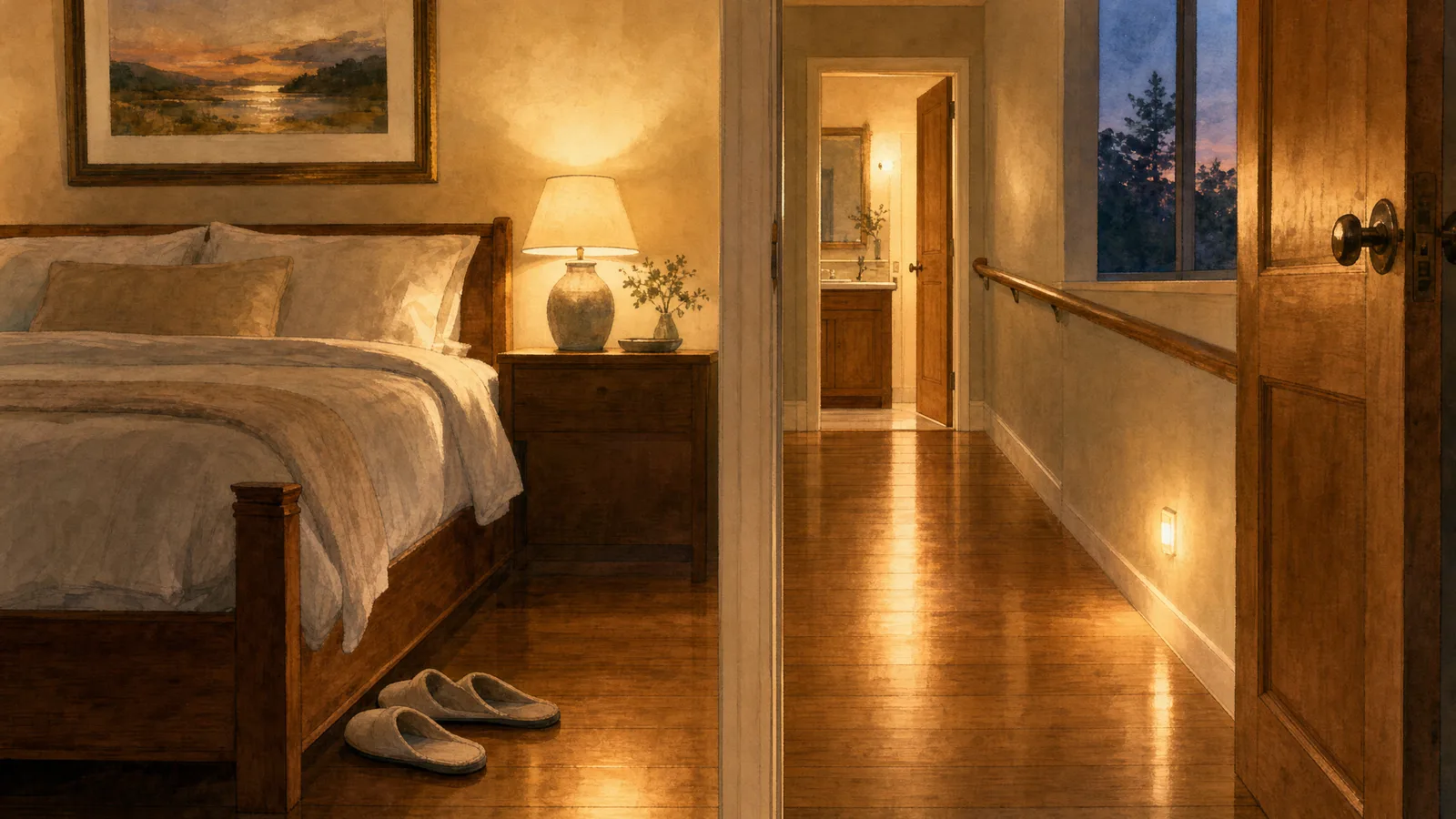
| 3. Poor Illumination & Shadows (Under 50 Lux) | High | -15 Points | Dual 3-way switches or motion-activated LED pathway lights at top, landing, and bottom | $30 – $120 |
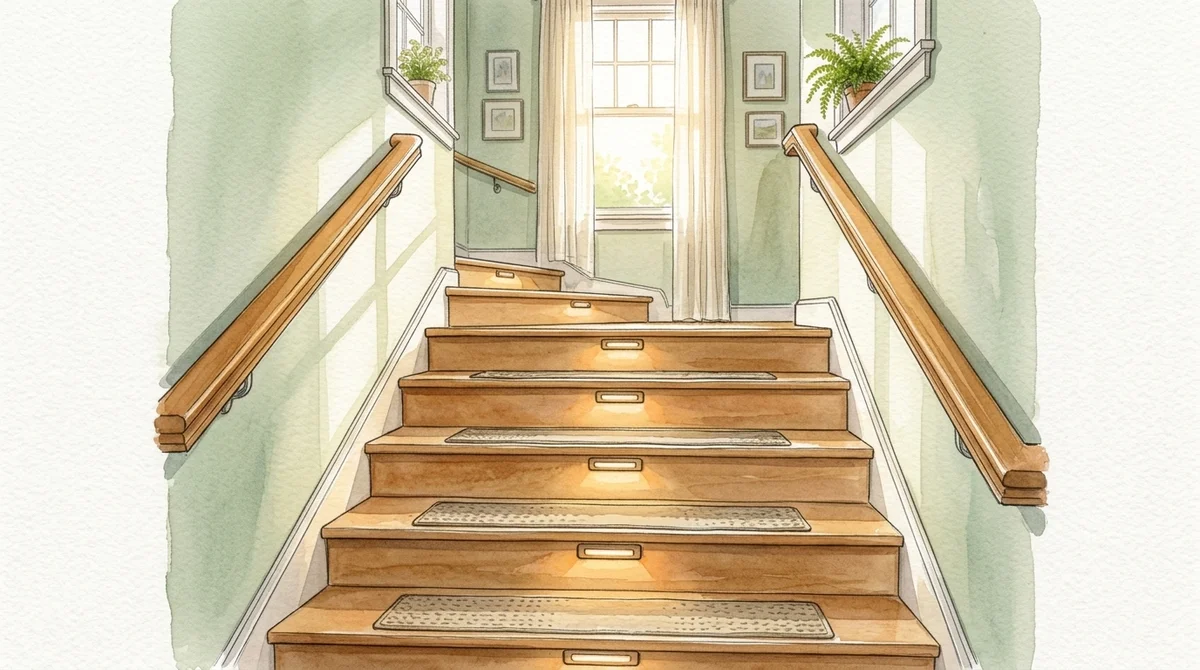
| 4. Visually Camouflaged Step Edges | High | -15 Points | Apply high-contrast non-slip nosing strips (e.g. dark rubber on light wood) | $25 – $50 |
| 5. Slick Hardwood or Loose Carpet Runner | High | -15 Points | Secure carpet runners with heavy-duty staples or install adhesive rubber tread mats | $40 – $120 |
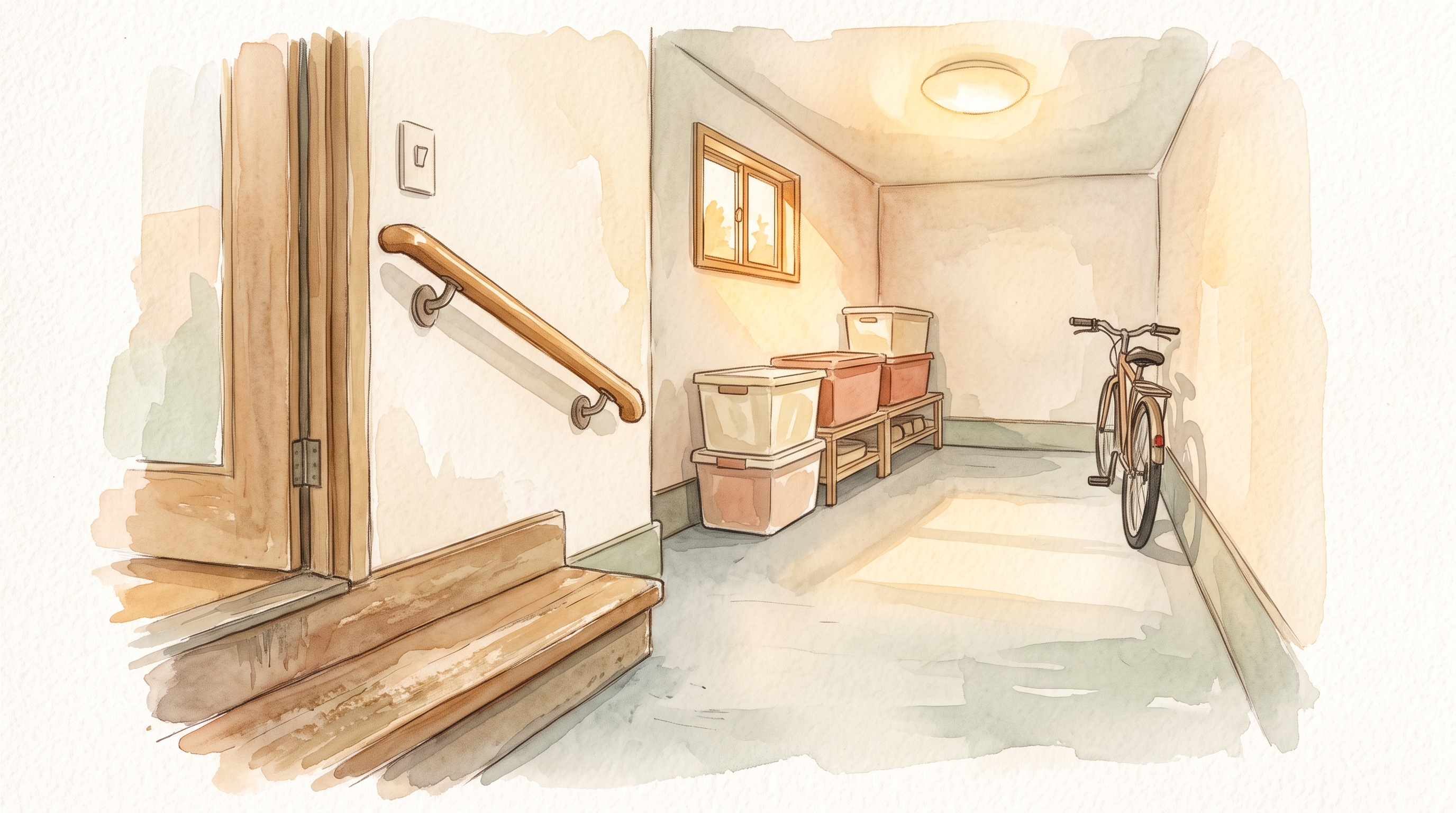
| 6. Raised Threshold at Hallway Transition | Moderate | -10 Points | Install beveled transition reducer ramp for thresholds exceeding 0.5 inches | $25 – $60 |
1. The Dual Handrail Rule: Why One Rail Leaves a Blind Side
Most residential building codes only mandate a handrail on one side of a staircase. For a healthy 30-year-old, one rail is sufficient. For an older adult, it creates an unavoidable biomechanical hazard.
Humans have a dominant side and, as we age, one leg or arm frequently develops asymmetry due to arthritis, stroke recovery, neuropathy, or knee surgery. When descending a staircase with a single rail on the right side, an older adult with right-side weakness has zero support on their dominant side when coming back up.
Clinical Specifications for Safe Handrails
- Continuous Dual Rails: Mount a handrail on both sides of the flight from top to bottom.
- The 12-Inch Extension: Falls frequently occur at the top landing (stepping down onto the first riser) and at the bottom landing (stepping off before feet are fully settled). Handrails should extend 12 inches horizontally past the final riser so the user has two hands firmly anchored before their feet change grade.
- The Power-Grip Profile: Avoid flat 2x4 decorative boards or wide architectural rails. A safe handrail must have a cylindrical or rounded oval profile with an outside diameter of 1.25 to 1.75 inches, allowing fingers and thumb to wrap completely around the rail in a secure "power grip."
- Wall Clearance: Ensure at least 1.5 inches of clearance between the rail and the drywall so knuckles never scrape or catch.
2. Visual Contrast & Step-Edge Camouflage
Aging eyes undergo physiological changes: the lens yellows, pupil dilation shrinks, and depth perception degrades significantly. When a staircase is covered in patterned carpet, or when uniform hardwood treads cast shadows onto identical risers, the edge of each step becomes visually invisible.
This optical illusion causes "misstepping"—either stepping too close to the edge and slipping forward, or overreaching and hyperextending a knee.
The Solution: High-Contrast Step Nosing
Apply a 1-inch to 2-inch high-contrast, non-slip strip along the leading edge of every tread:
- On light oak or blonde wood treads, apply a matte black or dark walnut nosing strip.
- On dark carpet or dark tile, apply a cream or golden-amber strip.
- Ensure the strip is flush and slip-resistant (rubber or fine-grit textured vinyl). Avoid thick plastic bullnoses that create a toe catch.
3. Stair Lifts: When Are They Truly Necessary?
A motorized stair lift is a powerful age-in-place tool, but families often rush to install one prematurely, which can inadvertently accelerate muscle atrophy by removing daily leg strengthening.
When to Consider a Stair Lift
- The senior has experienced a fall or near-miss on the stairs within the past 12 months.
- Severe cardiopulmonary fatigue (COPD, CHF) causes shortness of breath after climbing 3 to 4 steps.
- Advanced joint deterioration makes weight-bearing stair climbing clinically unsafe according to their physical therapist.
Cost and Feasibility Reality Check
- Straight Staircases: $2,800 to $4,500 installed. Straight rails are modular, install in 3 to 4 hours, and have strong resale value.
- Curved or Landed Staircases: $9,000 to $15,000+. Curved rails must be custom-manufactured in a fabrication shop using precise 3D photo-measurements of the staircase.
- Medicare Coverage: Traditional Medicare considers stair lifts an un-covered home modification. However, VA grants (HISA, SAH) and specific Medicaid HCBS waivers provide full or partial subsidies.
Frequently Asked Questions
How high should handrails be mounted on stairs for seniors?
According to ADA standards and residential safety codes, handrails should be mounted between 34 and 38 inches measured vertically from the leading edge of the stair tread to the top of the handrail gripping surface. Consistency along the entire run is essential so the hand does not experience sudden height drops.
Are carpeted stairs safer than hardwood stairs for older adults?
Not necessarily. While carpet provides softer cushioning if a fall occurs, thick pile carpet rounds out step edges and reduces tactile foot feedback, increasing slip risk. Hardwood with non-slip contrast nosing strips or tight commercial low-pile carpet securely stapled to both tread and riser provides the safest footing.
Does Medicare cover the cost of a stair lift?
No. Traditional Medicare Part B strictly classifies stair lifts as home modifications rather than Durable Medical Equipment (DME), meaning they are not covered. Veterans may qualify for assistance through VA HISA (Home Improvements and Structural Alterations) grants, and some state Medicaid waivers provide funding.
What lighting is best for staircases to prevent falls?
Stairways should be illuminated to at least 50 to 100 lux with zero dark patches or glare spots. Install dual three-way switches at both the top and bottom of the flight, paired with low-voltage motion-activated LED pathway lights installed along the baseboards that illuminate automatically when someone approaches in the dark.