Bedroom Fall Hazards: Safe Bed Height, Night Paths, and Rug Traps

The bedroom feels like the safest room in the home, but clinical data reveals a startling fact: nearly a third of residential falls occur within three feet of the bed. Most happen between midnight and 6:00 AM, when an older adult wakes up groggy to use the bathroom, reaches blindly for a lamp switch, or sits on an improper mattress edge.
Under the Home Safety Score scoring doctrine, bedroom safety centers on one critical transition: the bed-to-standing transfer. An improper bed height or dark transition route triggers immediate point deductions. Below is the breakdown of bedroom hazards, the exact clinical formula for bed height, and the truth about adult bed rails.
The 5 Bedroom Hazards Ranked by Severity
| Hazard Finding | Severity Tier | Safety Score Deduction | Standard Clinical Fix | Estimated Cost |
|---|---|---|---|---|
| 1. Improper Bed Height (Too High or Too Low) | Critical | -25 Points | Adjust bed frame, remove box spring, or install heavy-duty risers so knees are at 90° with feet flat | $0 – $60 |
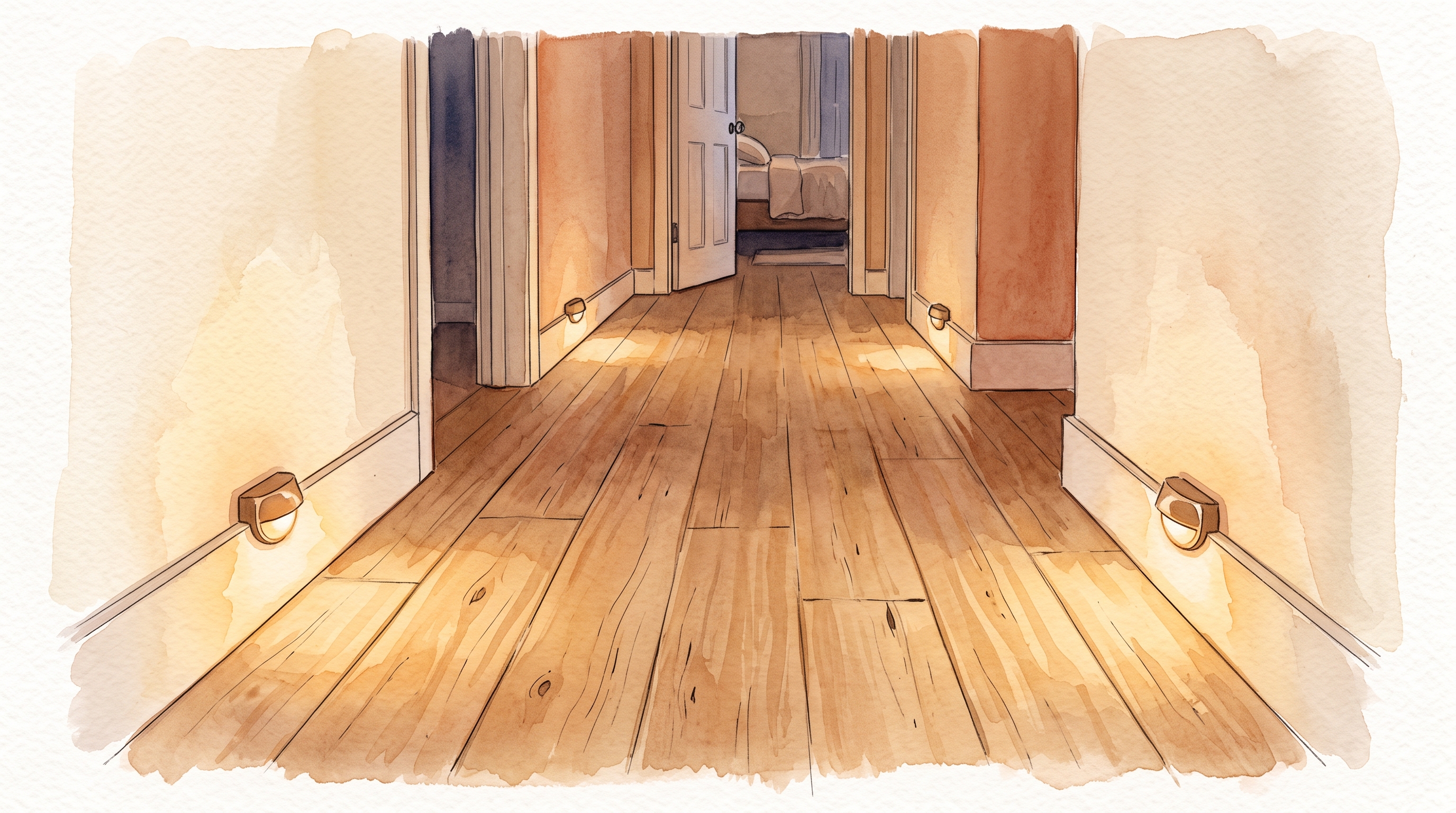
| 2. Dark Pathway to Doorway (Under 30 Lux) | High | -15 Points | Install under-bed motion LED light strips or plug-in amber nightlights that light upon swinging feet out | $20 – $35 |
| 3. Distant or Hard-to-Reach Bedside Lamp | High | -15 Points | Touch-activated lamp, voice smart bulb ("Alexa, light on"), or inline cord switch within arm's reach | $15 – $45 |
| 4. Unsecured Bedside Rugs & Trailing Runners | High | -15 Points | Remove bedside runner rugs or tape perimeter edges down with double-sided rug tape | $12 – $25 |
| 5. Collapsing Mattress Edge Support | Moderate | -10 Points | Mattress edge support bolster or structured mattress with reinforced perimeter coils | $40 – $400 |
1. The Bed Height Clinical Formula: The 90-Degree Rule
Bed height is one of the most frequently overlooked hazards in senior homes. Modern pillow-top mattresses and deep box springs have pushed standard bed heights to 28 to 32 inches off the floor. When an older adult sits on the edge, their feet dangle in the air. Stepping out requires sliding forward and dropping down onto the floor, causing sudden instability.
Conversely, platform beds or worn mattresses lower the seat to under 16 inches, forcing hips below knees and requiring massive leg thrust to stand.
How to Measure Proper Bed Height
- Have your parent sit upright on the edge of the mattress with their feet placed flat on the floor.
- Check the knee angle: Their knees should form a crisp 90-degree angle, with thighs parallel to the floor and heels firmly planted.
- The Golden Metric: For most older adults between 5'2" and 5'10", the ideal height from the floor to the top of the compressed mattress is 20 to 23 inches.
How to Fix It: If the bed is too high, swap the 9-inch box spring for a 4-inch low-profile box spring ($100) or remove the bed frame entirely. If the bed is too low, install certified 2-inch or 3-inch locking furniture risers with wide non-skid bases.
---2. Adult Bed Rails vs. Bed Assist Transfer Handles
Many families instinctively install full-length hospital-style bed rails to prevent an aging parent from rolling out of bed. However, federal safety regulators and the Consumer Product Safety Commission (CPSC) warn that full-length bed rails carry severe entrapment and suffocation risks for individuals with cognitive decline, who may attempt to climb over them and fall from a greater height.
The Safe Alternative: Bed Assist Handles
Instead of a barrier rail, install a Bed Assist Transfer Handle:
- Features a short horizontal grab bar (12 to 18 inches wide) anchored under the mattress with safety straps wrapping around the opposite bed rail.
- Does not confine the person in bed.
- Provides a firm, stable handhold to push up from lying to sitting, and gives leverage when standing up onto the floor.
3. Managing Orthostatic Hypotension: The 60-Second Pause
Many bedroom falls are not caused by physical obstacles, but by a sudden drop in blood pressure when shifting rapidly from lying flat to standing upright (known clinically as orthostatic hypotension). This causes sudden dizziness, lightheadedness, and temporary loss of postural control.
Teach your parent the "60-Second Pause" routine:
- Sit up slowly on the edge of the bed with feet flat on the floor.
- Count to 60 or pump ankles up and down five times to stimulate venous blood flow back to the heart.
- Ensure night lighting is illuminated before taking the first step.
Frequently Asked Questions
What is the ideal bed height for an elderly person?
The ideal bed height allows the older adult to sit on the edge with their feet flat on the floor and their knees bent at a 90-degree angle. For most seniors, this measures between 20 and 23 inches from the finished floor to the top of the mattress when seated. Beds higher than 25 inches or lower than 18 inches significantly increase fall risk.
Are bed rails safe for older adults at home?
Full-length side rails can be hazardous, posing risks of entrapment, strangulation, or falls if a person tries to climb over them. Safety experts recommend shorter "Bed Assist Handles" that anchor securely under the mattress, providing leverage to sit up and stand without creating an entrapment barrier.
How can I light a senior's bedroom at night without disturbing sleep?
Install under-bed motion-sensor LED light strips with an amber or warm white hue (under 2700K). These illuminate the floor automatically as soon as the senior swings their legs out of bed, providing clear pathway lighting without shining bright blue light into their eyes or disrupting circadian rhythms.