When the Power Fails, Your Plan Should Already Be in Your Pocket
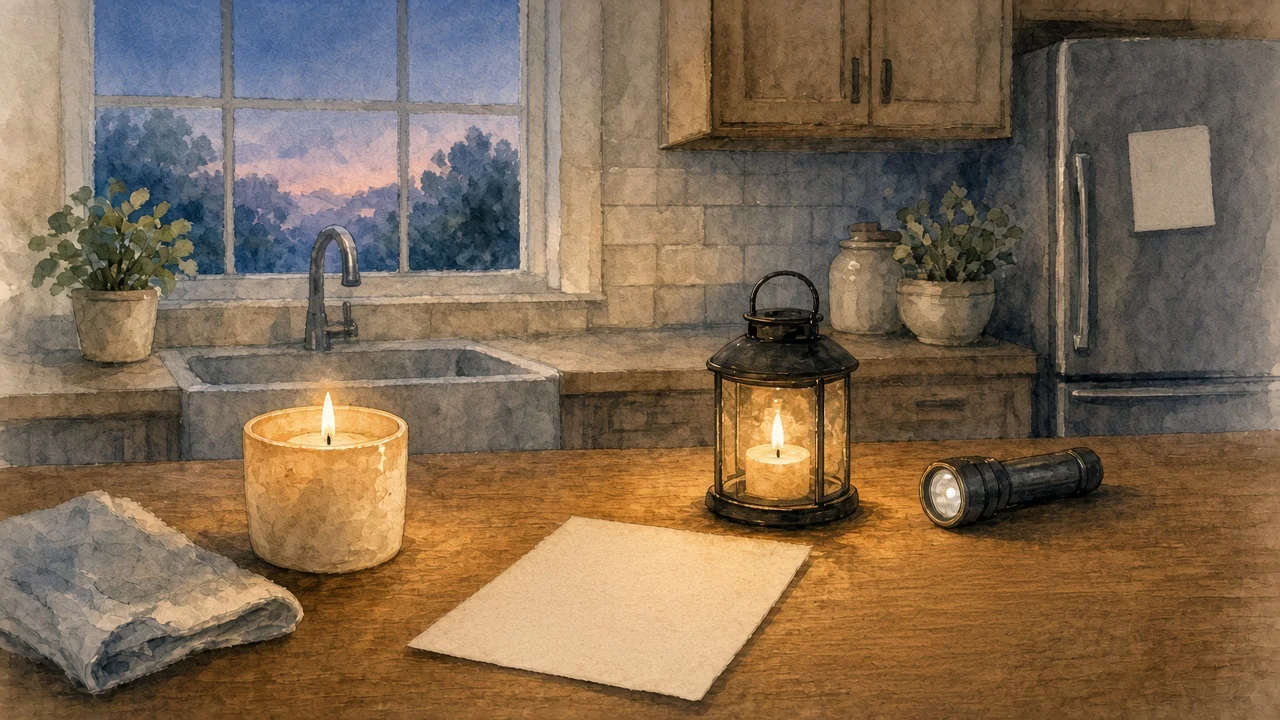
For older adults, no disaster is ever simple.
That idea anchors the October 2026 special issue of the Journal of Applied Gerontology, the peer-reviewed journal of the Southern Gerontological Society. In the opening editorial, "Complex Emergencies and the Effects on Older Populations," guest editor Lindsay Peterson, PhD, of the University of South Florida School of Aging Studies, writes with fellow guest editors Lisa M. Brown, PhD, ABPP, of Palo Alto University and David M. Dosa, MD, MPH, of UMass Chan Medical School. Their argument is direct: hurricanes, floods, wildfires, and extreme heat don't arrive one at a time for older people. These hazards stack on top of chronic illness, limited mobility, and thin social support, and each one makes the others harder to survive.
The issue gathers twelve studies from the United States, Puerto Rico, and China, covering people living at home with home- and community-based care, people in assisted living, and people in nursing homes. One finding should matter to every family: even older adults who manage chronic conditions every day may have no concrete plan for their medications, their powered medical equipment, or reaching their doctors when disaster hits.
Someone who keeps their pill schedule, oxygen, and appointments in perfect order on a normal Tuesday can still be caught unprepared when the power fails and the roads close. Competence in daily care is not the same as readiness for a crisis. That gap is one of the most useful things this research names.
Who the Research Serves
The special issue speaks mainly to the people who design and run the systems around older adults: researchers, policymakers, emergency managers, clinicians, home health agencies, and leaders of assisted living communities and nursing homes. Studies in the issue examine how disasters disrupt home health and therapy services well beyond the area that was hit, and how differences in staffing and organization leave some facilities far better prepared than others. The editors call for building disaster planning into routine clinical care and strengthening the organizations older adults depend on.
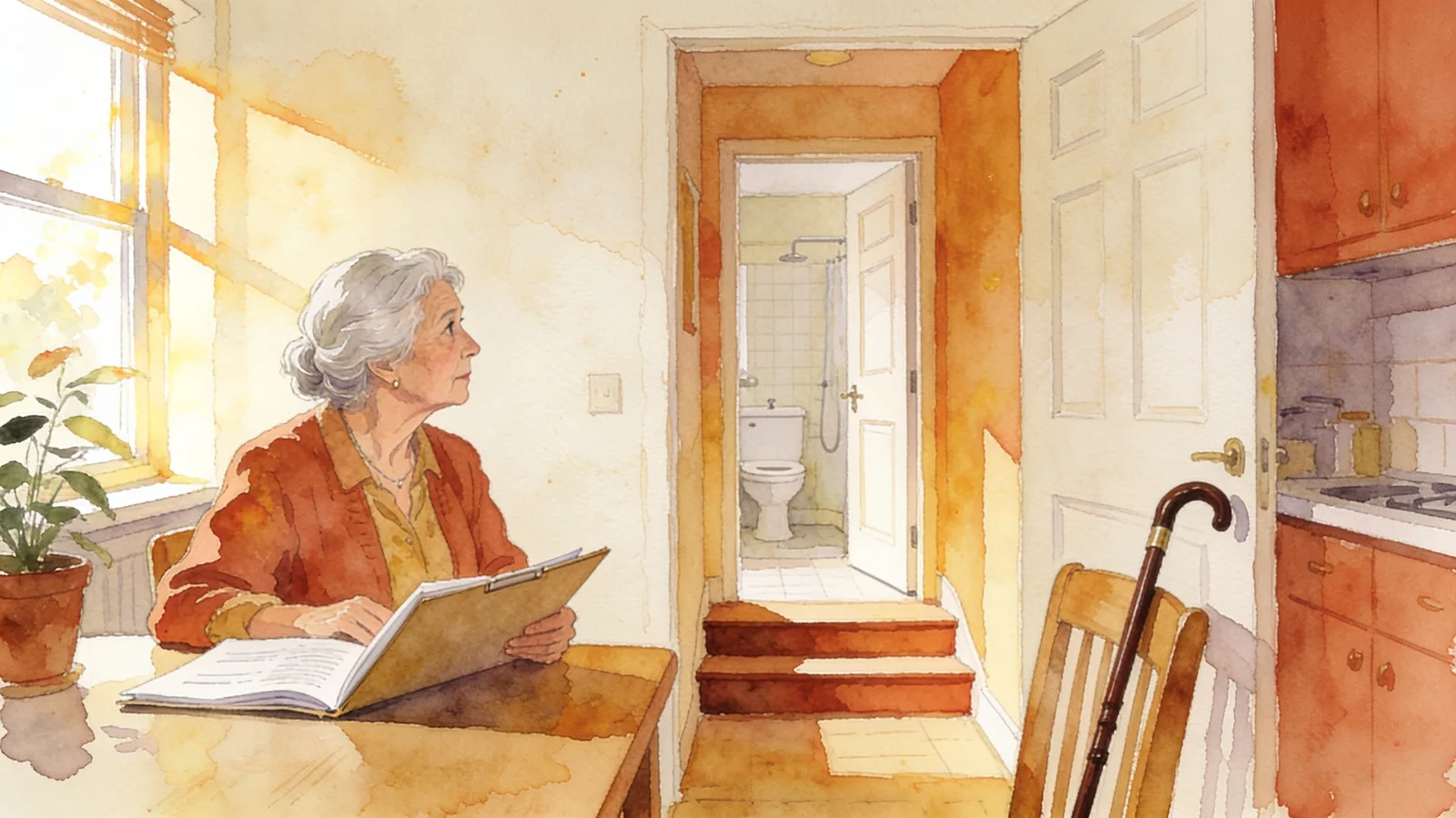
That work matters, and it belongs to those institutions. But most older adults don't live in a facility. They live at home, often with a spouse, a neighbor, or an adult child who is a phone call or a few states away. So what does this research mean for them?
The editors also name factors that protect people: prior experience, resilience, hope, self-efficacy, caregiving relationships, and timely, relevant information. Several of these can be built at the kitchen table.
Peterson puts it plainly: "Motivation alone is not enough." In her words, older adults "need information that is timely, relevant, and meets their needs and life circumstances. And they need better support from all the organizations with a role in disaster planning and recovery, from emergency management and health care providers to home care, respite, and long-term care facilities."
Brown widens the lens beyond physical health. "Disasters do not only threaten physical health. For older adults, they can cut people off from normal routines, relationships, and the caregivers they rely on. Those losses can have lasting psychological effects." She argues that preparedness has to include mental health and support for caregivers.
Dosa reminds us what is at stake for everyone: "Disasters are apolitical events. We must do our very best as a society to understand how best to prepare for and respond to disasters."
For families, the takeaway is simple. Wanting to be ready isn't enough. You need the right information, in the right place, before you need it, and a way to stay connected to the people who help.
The Household Architecture: What to Complete This Week
Our founder, Brian Fluhr, brought property-centric disaster data products to market and worked directly with the U.S. Department of Veterans Affairs to supply appraisal data before and after disasters. The lesson he carried from that work: the first hours matter most, and what helps in those hours is information you can reach right away.
None of this requires a new way of living. It means writing down what you already know and putting it where you and your family can get to it fast.
1. Put your plan on your phone first. Your phone is already in your pocket or on the nightstand. Keep your emergency information there. Then print a backup of your key contacts, conditions, allergies, devices, and care team for the fridge and your wallet, in case the battery dies or a responder needs to see it at a glance.
2. Write down who to call, in order. Not just a list of names. Who's first? Who lives close enough to come? Who has a key? In a crisis, a short ordered list is faster than a long contact list.
3. Get every medicine into one list on your phone. Include the name, dose, and timing of each one, and what each is for. Note anything that has to stay cold. If you have to leave home, this list helps a pharmacist or doctor keep you on track.
4. Name your equipment. If you use oxygen, a powered wheelchair, a CPAP, or anything else that needs electricity, write it down along with your supplier's name and number. Ask your utility and local emergency office whether they keep a list of residents who depend on power, and register if they do.
5. Know where your papers are. You don't need to carry your power of attorney or health care instructions everywhere. Someone you trust does need to know where they are.
6. Pack a go-bag and put it by the door. This one is up to you, and it's worth an afternoon. Pack a few days of medicines, spare glasses and hearing aid batteries, chargers and a battery pack, water, snacks, a flashlight, comfortable shoes, and copies of your insurance cards. If you have a pet, add food, a leash, and their medicines. Keep the bag somewhere easy to grab.
7. Agree on a daily check-in. Choose a simple daily signal with someone you trust. It's part of a normal routine, and it's also how someone learns quickly when things aren't normal.
8. Talk about the hard part. Brown is right that disasters cut people off from routines and relationships. Talk with your family now about where you'd go, who you'd want with you, and what would help you feel steady.
How SeniorThrive Supports the Plan
SeniorThrive is built around three things families care about: the person, the home, and the connections that keep both strong. For disaster readiness, the app holds much of the information that goes with your go-bag. Here's what's live today.
Free, for everyone:
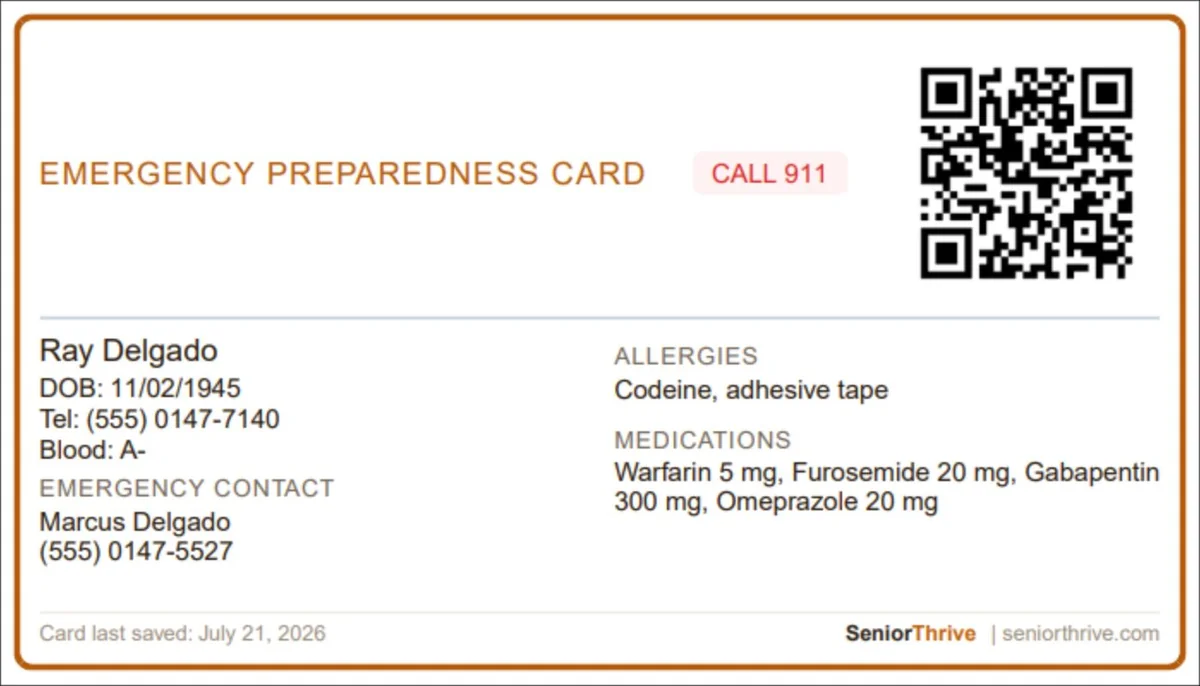
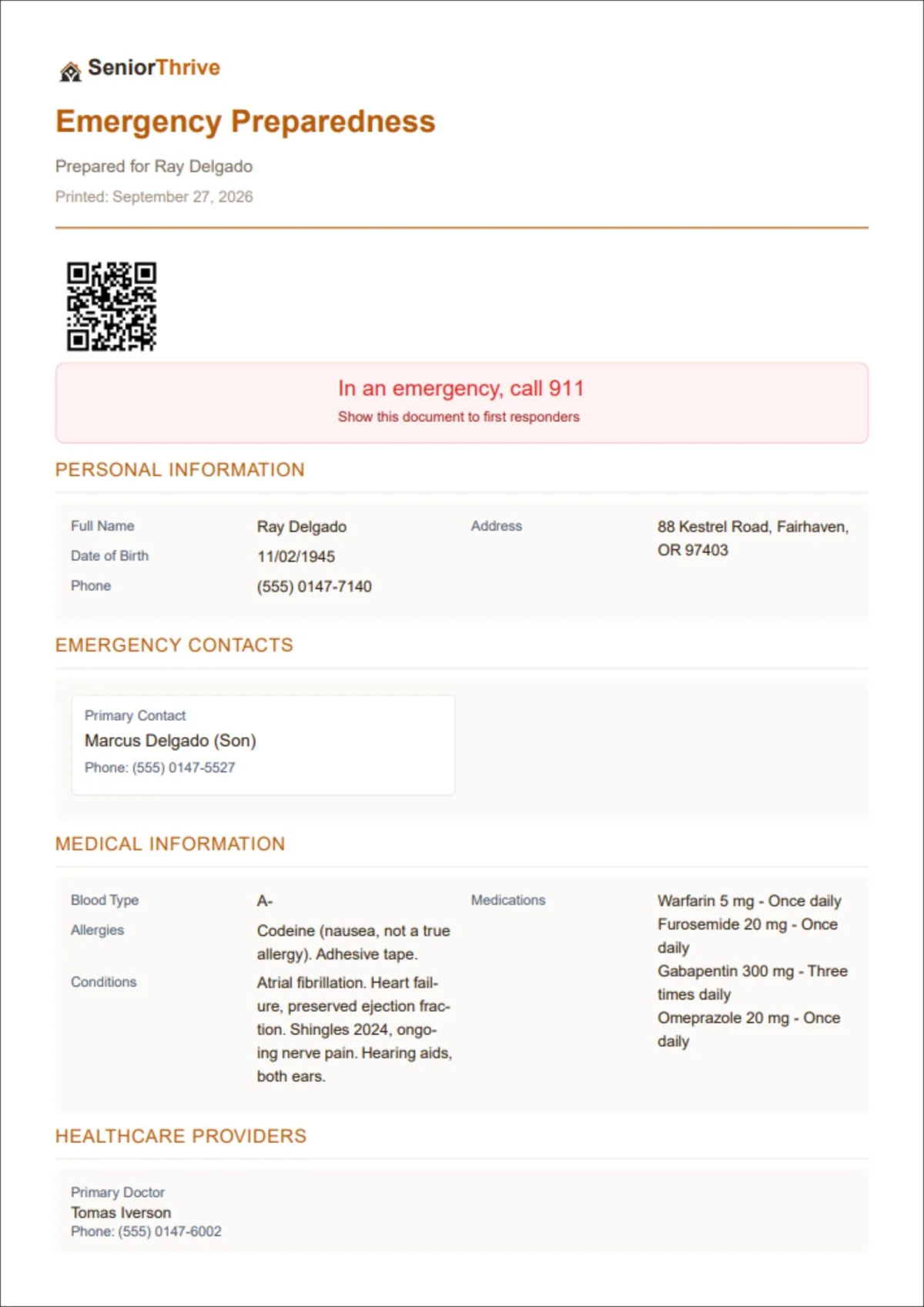
- Emergency Preparedness. One place for your ordered Who to Call list, allergies and conditions, medical devices (including oxygen), your doctors, preferred hospital, pharmacy, and insurance IDs. It's in the app whenever you need it, and you can print it as a fridge sheet and a wallet card for backup.
- My Daily Check-In. A simple daily rhythm that builds what the research calls self-efficacy: knowing how you're doing and acting on it.
- My Home, Step by Step. Guidance for making your home safer, one room and one step at a time.
With Essential:
- My Medicines. Your full medicine list on your phone, ready if you need to show a pharmacist or doctor.
- My Documents. A record of where your important papers are kept, including your power of attorney and health care instructions, so the right person can find them.
- Morning Peace of Mind. If you miss your morning check-in, the Circle members you've chosen get an in-app and push alert. Connection, without anyone watching you.
- Room Safety Check and Home Safety Score. A clear picture of how your home is set up, and what to work on first.
- Mobility Check. A practical look at how you get around your home and community.
- Emergency Pet Care Card. So the animals you love aren't forgotten.
- Circle sharing. Invite family or trusted friends into your Circle. You decide who sees what.
Here's the line between you and the app: you pack the bag and put it by the door, and SeniorThrive holds the information that goes with it. We don't deliver supplies or map evacuation routes. We help keep your contacts, medicines, papers, and the people who care about you organized and within reach.
Privacy matters most when you're sharing health information. You own your data. We do not sell it. You decide who sees it. And nothing watches you.
Action Over Assumption
The researchers behind this special issue have done the hard work of naming what's missing. Institutions have their part to play. Families have theirs, and much of it can start today with a phone, a short list, and a conversation.
Don't assume the plan exists because the daily routine works. Write it down, put it in your pocket, and share it with the people who would come for you.
Thriving at home means being ready for the bad day as well as enjoying the good ones.
Start with free Emergency Preparedness
Start with the free Emergency Preparedness tools in SeniorThrive. Add who to call, your allergies and conditions, your devices, and your doctors. It's ready on your phone, and you can print a backup for the fridge and your wallet. Then pack your go-bag yourself and put it by the door.
Sources
- Peterson, L. (2026). "Complex Emergencies and the Effects on Older Populations." Editorial. Journal of Applied Gerontology. https://doi.org/10.1177/07334648261472656 (free to access). Guest editors for the special issue include Lisa M. Brown, PhD, ABPP, and David M. Dosa, MD, MPH.
- EurekAlert! (Oct 2, 2026). "New editorial in special issue calls for stronger disaster preparedness for older adults." https://www.eurekalert.org/news-releases/1146373 (source for the Peterson, Brown, and Dosa quotes).
- Scienmag (Oct 2, 2026). "Gerontologists urge stronger disaster planning as complex emergencies threaten aging populations." https://scienmag.com/gerontologists-urge-stronger-disaster-planning-as-complex-emergencies-threaten-aging-populations/