My Elderly Parent Keeps Falling: The 72-Hour Action Plan
The first fall you wrote off as bad luck. A rogue throw rug, a missed step in the dark, or rushing to answer the phone. You helped your parent up, checked for bruises, and told each other to be more careful. But then came the second fall three months later. And last night, your phone rang at 2:00 AM.
When an aging parent falls repeatedly, it triggers a unique, suffocating wave of caregiver anxiety. You find yourself checking your phone with a jolt of panic every time an unknown number flashes. You replay worst-case scenarios in your head: a fractured hip, hours lying helpless on cold tile, a sudden spiral into nursing home placement.
Here is what emergency room physicians, geriatricians, and occupational therapists want you to know: recurring falls are never normal, but they are almost never random. A fall is not an isolated bad moment; it is a clinical symptom. When you stop treating each fall like an accident and start investigating it like a medical puzzle, you can break the cycle.
Below is the emergency roadmap: what to check in the first 72 hours, the four hidden medical triggers families routinely overlook, how to handle walker resistance without screaming matches, and the five-step protocol to keep your parent safe at home.
Critical Safety Check: The 72-Hour Post-Fall Protocol
If your parent has fallen within the last 72 hours, check these three non-negotiables before reading further:
- 1. Are they on blood thinners? If your parent takes Eliquis, Xarelto, Plavix, or Warfarin and bumped their head (even a slight bump), go to the Emergency Department immediately. Blood thinners turn minor head trauma into delayed, fatal subdural hematomas that can take days to manifest symptoms.
- 2. Can they bear weight without groaning? Inability to put weight on a leg or an externally rotated, shortened leg is a hallmark sign of a fractured femoral neck (hip fracture). Do not attempt to transport them in a car; call 911 for EMT transport.
- 3. Did they lose consciousness? If the fall was preceded by blacking out, chest fluttering, or confusion, it was likely a syncope event (cardiac arrhythmia, stroke, or severe blood pressure drop) rather than a mechanical trip.
The 4 Hidden Root Causes Behind "Unexplained" Recurring Falls
When asked why they fell, older adults almost always say: "I just caught my toe on the carpet" or "My knee gave out for a second." In reality, mechanical tripping is usually just the final straw. The underlying vulnerability is almost always biological:
| Root Cause Trigger | How It Triggers a Fall | Warning Signs to Watch For | Diagnostic Action Required |
|---|---|---|---|
| 1. Silent Urinary Tract Infection (UTI) | In seniors, UTIs rarely cause pain or fever; they trigger sudden acute confusion, ataxia (staggering), and muscle weakness | Sudden behavior change, new incontinence, stumbling within 48 hours | Urinalysis and urine culture (urgent care or primary care) |
| 2. Medication Side Effects & Polypharmacy | Interactions between sedatives, sleep aids, and blood pressure pills cause sedation and impaired reflexes | Drowsiness after morning pills; frequent morning or 2:00 AM falls | Comprehensive pharmacist Beers List medication review |
| 3. Orthostatic Hypotension | Blood pools in legs when sitting/lying down; standing causes sudden brain oxygen starvation and dizziness | Falls occur within 30 to 60 seconds of standing up from bed or favorite chair | Lying-to-standing orthostatic blood pressure check (3-position test) |
| 4. Visuoperceptual & Depth Loss | Cataracts, macular degeneration, or bifocal lens distortion make step edges and floor transitions invisible | Hesitation at doorways; shuffling on patterned carpets; misstepping at bottom stair | Comprehensive dilated eye exam; transition to single-vision walking glasses |
The "Fear of Falling" Paradox: Why Being Careful Causes More Falls
After an initial fall, seniors develop what geriatricians term Fear of Falling Syndrome (FoF). It is an entirely natural psychological reaction, but it triggers a disastrous biomechanical trap:
- The Protective Stiffening: Fear causes the senior to stiffen their hip and ankle joints, shorten their stride, and cast their eyes downward to watch their feet.
- The Loss of Balance Reflexes: Walking stiffly with rigid knees prevents the natural ankle flexion needed to recover from a minor stumble.
- Muscle Atrophy: Terrified of another fall, the senior limits their movement, stays in their chair, and stops walking outside. Within three to four weeks of inactivity, quadricep strength declines by up to 20%, ensuring that the next time they stand, their legs are significantly weaker.
The takeaway: You cannot protect an older adult from falling by encouraging them to stay seated. Immobility accelerates fall risk. The only proven medical defense is dynamic strength and balance training (like physical therapy or Tai Chi for balance).
---The Walker Dilemma: Why Parents Refuse Assistive Devices
"Dad has a $150 four-wheeled rollator sitting in the front hallway, but he refuses to touch it. He furniture-walks from table to wall while holding a cup of hot coffee."
Every adult child has lived this frustration. When you plead, "Dad, you have to use your walker!", he hears something completely different: "Dad, you are an invalid, your youth is gone, and you are one step away from a nursing home."
How to Reframe the Conversation
- Stop Calling It a Mobility Aid: Reframe the device around stamina and freedom. "Dad, this rollator has a padded seat. It means we can go to the botanical gardens or the grandkid's soccer game, and whenever you want a breather, your chair is right with you."
- Get an Occupational Therapist to Prescribe It: When advice comes from an adult child, it feels like bossy parental role-reversal. When a clinical therapist adjusts the handle height to the wrist crease, demonstrates the turning radius, and says, "This is your prescription tool to stay in this house," resistance drops by 80%.
- Audit the Pathway Width: Frequently, seniors leave walkers behind because their hallways and doorways are too narrow (under 32 inches) or blocked by coffee tables. Clear a continuous 36-inch path so the device moves smoothly without banging into walls.
The Truth About Medical Alert Systems
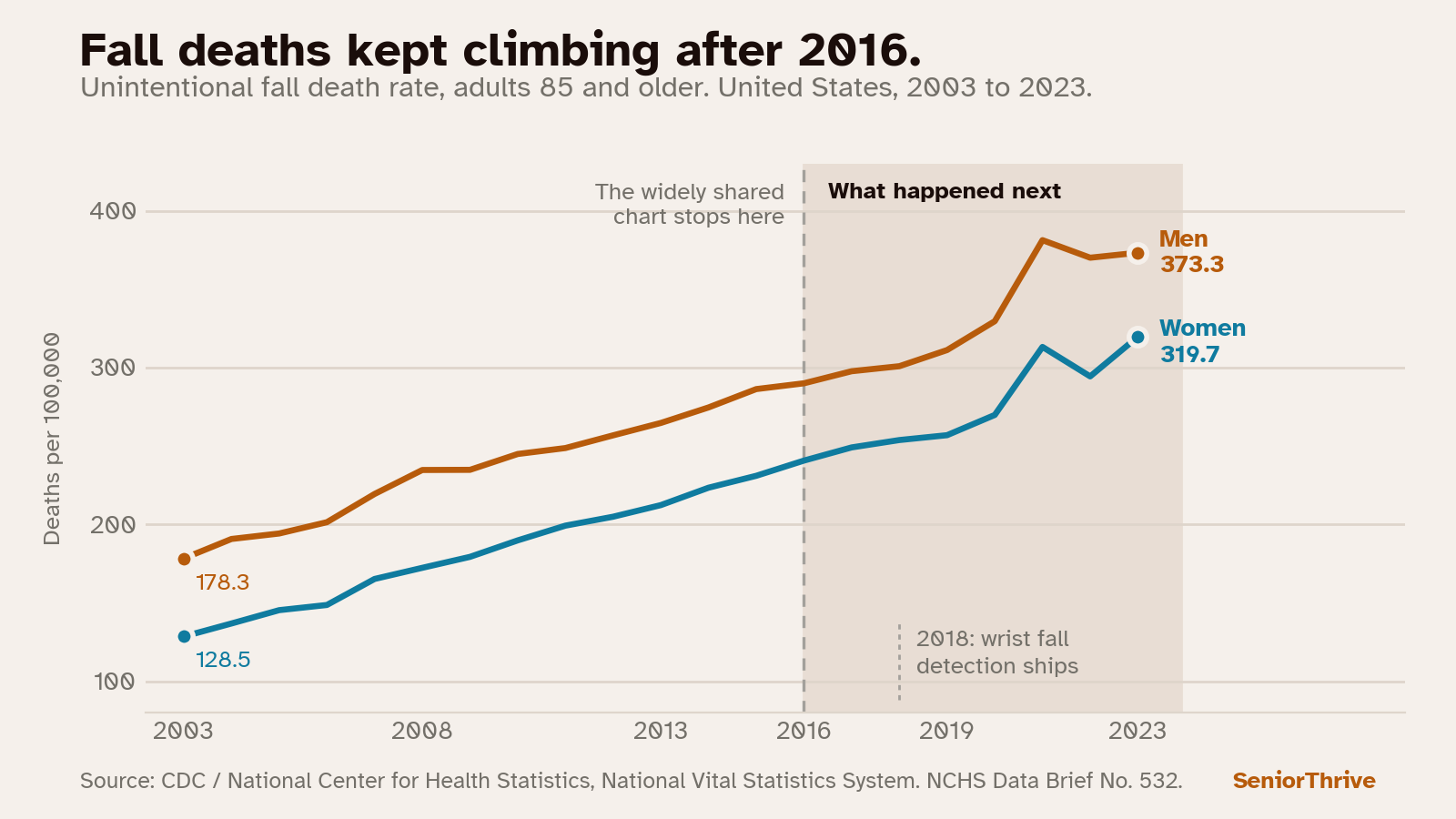
Television commercials depict medical alert buttons as magic lifesavers: an older adult falls, presses a pendant button around their neck, and help arrives instantly. But in emergency medicine, the real statistics are sobering:
The Uncomfortable Reality of Alert Buttons
Studies consistently show that in more than 80% of actual fall incidents, the senior was NOT wearing their emergency pendant. They took it off to shower (where slips happen most), left it on the bedside nightstand, or refused to wear it out of embarrassment. Furthermore, when falls result in head strikes or loss of consciousness, a manual push-button is completely useless.
What to Prioritize Instead
- Automatic Fall Detection Sensors: Select systems with built-in 3D accelerometers and barometric sensors that automatically detect the rapid descent and sudden impact of a fall without requiring manual button pushes.
- Voice-Activated Smart Speakers: Place affordable smart speakers (like Amazon Echo or Google Nest) in bedrooms and bathrooms. If your parent falls and cannot reach their phone or pendant, they can call out: "Alexa, call Sarah!" from the floor.
- Ambient Motion & Contact Sensors: Install non-intrusive motion sensors that alert family members via an app if no movement is detected between 7:00 AM and 10:00 AM, verifying their morning routine without cameras.
- Beware Predatory Contracts: Never sign a multi-year auto-renewing medical alert monitoring contract. Insist on month-to-month service that can be cancelled with zero penalty.
The 5-Step Emergency Fall Prevention Protocol
If your parent has fallen more than once, follow this systematic action plan:
-
Step 1: Request a "3-Position Blood Pressure" and Medication Audit
Schedule an in-person primary care appointment. Ask the nurse to check their blood pressure lying down, sitting, and standing (after 1 and 3 minutes) to diagnose orthostatic hypotension. Hand their complete medication list to a clinical pharmacist to identify fall-risk sedatives. -
Step 2: Obtain a Doctor's Order for In-Home Physical & Occupational Therapy
If your parent has fallen, Medicare Part B covers in-home physical therapy under the homebound benefit or outpatient mobile therapy. Ask their doctor to write a script: "Physical therapy for gait instability and balance retraining; Occupational therapy for home safety assessment." -
Step 3: Run the Home Safety Score Room Audit
Walk through the house room-by-room using our free Home Safety Score methodology. Fix the high-severity hazards immediately: pull up all throw rugs, install stud-anchored bathroom grab bars, and eliminate dark floor paths. (For a quick preliminary check, run through our 2-minute Home Safety Check-In). -
Step 4: Audit Their Footwear & Eyewear
Throw away floppy open-backed scuff slippers and loose socks, which cause thousands of indoor slips. Transition to supportive, closed-heel indoor walking shoes with thin, firm, non-skid soles. If they wear bifocals, request single-vision lenses for walking and stairs. -
Step 5: Hold a Transparent Family Boundary Conversation
Repeated falls strain adult siblings. One child panics and wants immediate nursing home placement; another lives 500 miles away and thinks Mom is fine. Use The SeniorThrive 5-Question Framework to establish objective, clinical boundaries on when home modifications are sufficient and what lines require professional care.
To compare the modest investment of home modifications against the catastrophic reality of hospital bills ($40,000+ for fall trauma), run your family's numbers in our interactive Value Calculator.
---Frequently Asked Questions
What causes frequent falls in the elderly?
Frequent recurring falls are typically caused by an intersection of medical and environmental factors: (1) silent urinary tract infections (UTIs) causing sudden confusion; (2) medication side effects and drug interactions; (3) orthostatic hypotension (blood pressure drops upon standing); (4) muscle weakness and peripheral neuropathy in the feet; (5) sensory changes like cataracts or bifocal distortion; and (6) physical home hazards such as throw rugs, dark hallways, and missing grab bars.
What should you do immediately after an elderly parent falls?
First, keep them calm and still—do not rush to pull them up. Check for pain, head trauma, broken bones, or bleeding. If they take blood thinners and struck their head, call 911 or go to the Emergency Room immediately due to brain bleed risk. If there is no severe pain, assist them into a sturdy chair using a controlled four-point crawl method, and monitor for delayed dizziness or confusion over the next 48 hours.
Why do seniors hide their falls from their adult children?
Older adults frequently hide falls and near-misses out of intense fear: they worry that admitting to a fall will cause their children to take away their car keys, strip away their independence, or force them into an assisted living facility or nursing home. Reframing discussions around supportive home modifications rather than institutional placement helps foster transparency.
How can I convince an elderly parent to use a walker?
To overcome walker resistance: (1) have an Occupational or Physical Therapist prescribe and professionally fit the device, removing the friction of parent-child role reversal; (2) reframe the walker as an endurance tool that enables independence and social outings rather than a sign of disability; (3) choose a modern, lightweight rollator with a built-in padded seat; and (4) ensure indoor home pathways are widened to at least 36 inches.
Do automatic fall detection alert buttons really work?
Modern fall detection pendants utilize 3D accelerometers and barometric pressure sensors to detect rapid drops and sudden stops with approximately 85% to 90% accuracy. However, they can produce false alarms during brisk sitting or drop incidents. Pairing fall-detection pendants with hands-free voice speakers and ambient home motion sensors provides the most reliable safety net.
Does Medicare cover physical therapy for fall prevention?
Yes. Medicare Part B covers physical therapy and occupational therapy to improve balance, rebuild gait stability, and prevent falls when ordered by a medical physician under a documented plan of care. Therapy can be delivered in an outpatient clinic or in the patient's home through home health or mobile outpatient therapy providers.