When Your Family Thinks You Should Move: How to Keep Your Independence and Clear the Air
It starts with subtle comments. A daughter noticing dishes left in the sink: "Mom, this kitchen must be exhausting to clean every day." A son lingering at the bottom of the staircase: "Dad, wouldn't a one-level condo or a senior community be so much simpler?" Then brochures start appearing on the kitchen counter.
You have lived in your home for decades. You know the creak of the third stair, the exact angle the afternoon sun hits the living room armchair, and every neighbor on the block. The thought of packing your lifetime of memories into two suitcases to move into an eighteen-foot assisted living room feels less like "peace of mind" and more like an eviction from your own life.
Here is the reality that both older adults and adult children often miss: Moving conversations rarely stem from a desire to control. They stem from unmanaged panic. Your children love you, but when they visit and notice small stumbles, unopened mail, or darkened hallways, their imagination races straight to catastrophic emergencies.
To stop the moving pressure, you do not need to fight or withdraw into silence. You need to dismantle the anxiety driving it. Here is the exact blueprint to take charge, demonstrate proactive safety, and turn tense dinner-table confrontations into mutual respect.
Want an Objective Baseline for Your Home?
Rather than arguing over subjective opinions, take 5 minutes to calculate your home's factual safety rating. Complete the free Home Safety Score to identify exactly what modifications eliminate risk while preserving your independence.
Why Your Family Brings Up Moving (The 4 Hidden Triggers)
When adult children suggest moving, they almost never understand the emotional cost of uprooting a life. Instead, they are reacting to four specific warning flags they don't know how to talk about:
| What They Saw | What They Fear | What They Say | The Reality |
|---|---|---|---|
| A bruise, limp, or dented bumper | A catastrophic fall where you lie on the floor for 12 hours alone | "This house is getting dangerous for you." | The house isn't dangerous; specific rooms have unmitigated hazards (lighting, rugs, high tub walls). |
| Stacks of unread mail or unpaid bills | Rapid cognitive decline or predatory financial exploitation | "Wouldn't it be nice if someone handled everything for you?" | Complex administrative overhead is annoying to everyone. Direct deposit and autopay fix 90% of it. |
| Spoiled food in the refrigerator | Malnutrition, inability to cook safely, forgetting the stove | "Senior dining rooms serve three chef-prepared meals a day!" | Cooking for one person is tedious. Meal prep delivery or weekly family casseroles solve nutrition effortlessly. |
| You spending days alone at home | Crushing isolation, depression, cognitive atrophy | "You'd have so many friends and activities down the hall." | Living alone does not equal loneliness. But maintaining purposeful social ties requires an intentional weekly schedule. |
The 4-Step Strategy to Keep Your Home and Stop the Nagging
When someone tells you what to do with your life, your natural reflex is defensiveness: "I've lived here 40 years, I'm fine, leave me alone." But defensiveness signals to your children that you are in denial. To end the moving conversation permanently, replace resistance with executive leadership.
Step 1: Call the Family Meeting Yourself
Do not wait for Thanksgiving or Sunday dinner for someone to drop another passive-aggressive remark. Take the initiative. Invite your adult children over or schedule a phone call with an explicit agenda:
"I know you have concerns about me living in this house alone. I love you for caring about my safety. Let's sit down this Saturday for 45 minutes. I want to share my long-term aging plan with you, hear your biggest worries, and show you the concrete safeguards I am putting in place."
The moment you initiate the meeting, the power dynamic shifts. You are no longer a passive patient being managed; you are the CEO of your own life consulting with your advisory board.
Step 2: Concede the Friction Points
If you claim that everything in a two-story, four-bedroom house is effortless, your children won't believe you. Honesty buys credibility. Identify the tasks you genuinely dislike and delegate them:
- "I love this house, but I hate cleaning the upstairs gutters and vacuuming the basement stairs."
- "I want to stay here, but driving in torrential rain at night makes me uncomfortable."
- "I have no desire to give up my garden, but weeding for four hours in July hurts my knees."
Hiring a neighborhood teenager to mow the lawn or using grocery delivery is not a sign of surrender. It is how high-functioning adults remain independent.
Step 3: Remove the Invisible Traps Before They Trigger a Crisis
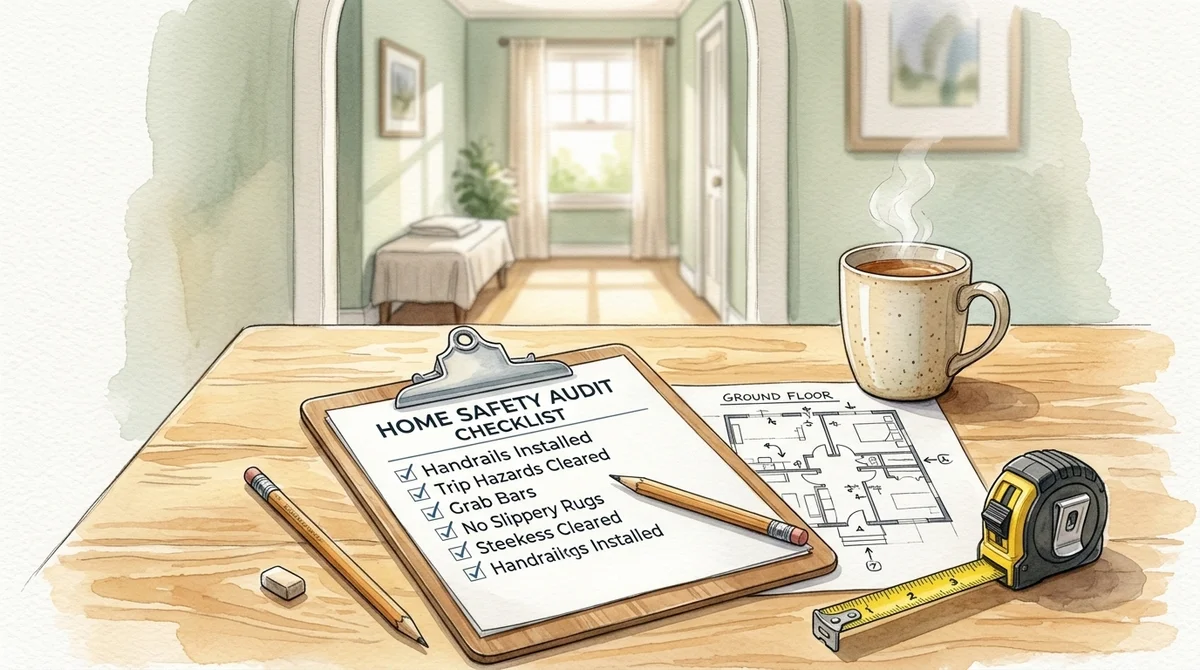
Ninety percent of sudden, forced moves to assisted living happen directly from a hospital emergency room after a fall. If you prevent the fall, you prevent the move. Implement the high-impact environmental upgrades immediately:
- Bathroom Grab Bars: Install professional grab bars anchored into wall studs at the shower entry, inside the stall, and beside the toilet. Ditch suction-cup handles, which fail under body weight.
- Motion-Activated Path Lighting: Place automated night lights from the bedside to the bathroom. Nighttime navigation in the dark is the single highest cause of hip fractures.
- Stair Railings on Both Sides: Ensure continuous handrails run from top to bottom on both sides of any staircase.
- Eliminate Throw Rugs: Remove loose runner rugs or anchor them with heavy-duty commercial rug tape.
Step 4: Establish the "Emergency Protocol"
Your children's deepest nightmare is that something happens and they won't know for days. Give them proof that won't happen. Choose a transparent system:
- A discreet daily check-in routine (such as our free Safety Net tool).
- A smart watch with automatic crash and fall detection that you promise to actually wear.
- A lockbox on the front porch with a spare key, whose code is known to family and local EMS.
The Conversation Script: Adult-to-Adult Boundaries
When the conversation happens, use this proven dialogue framework to preserve both your dignity and your relationship:
When your child says:
"Mom, you fell last month. You can't stay here anymore. It's simply not safe."
You respond:
"You were terrified when I fell, and I understand why. That scared me too. But moving out of my home is not the only way to solve fall risk. I had an occupational assessment done, I installed dual grab bars, and I began physical therapy for balance twice a week. Let's look at the home checklist together. If I have another fall within six months despite these safeguards, I promise we will sit down and evaluate care options together."
When your child says:
"All of my friends' parents love their retirement community. You wouldn't have to worry about cooking or maintenance ever again."
You respond:
"That community might be wonderful for them, but my peace of mind comes from my garden, my woodworking shop, and my quiet routine here. Assisted living costs between $4,500 and $7,000 every month. For a fraction of that cost, we can hire weekly housekeeping and meal support while leaving my life intact. Let's compare the numbers on the Value Calculator before making assumptions."
When Moving Truly Is the Right Choice
Aging in place is SeniorThrive's mission, but we believe in honesty above all else. There are clear medical and cognitive thresholds where continuing to live alone without 24/7 care poses life-threatening hazards:
- Moderate to Severe Dementia with Wandering: If an individual leaves the house at night, becomes disoriented outdoors, or leaves the gas burner on without memory of doing so.
- Total Inability to Perform Transferring Unassisted: Requiring two people to transfer safely from bed to wheelchair, where home care cannot be staffed around the clock.
- Caregiver Burnout Threatening a Spouse's Survival: When an aging spouse attempting full-time physical care is deteriorating rapidly from sleep deprivation and physical injury.
If these thresholds have not been crossed, your home can almost always be adapted. Independence is not all-or-nothing—it is a continuum supported by the right tools, honest family conversations, and proactive safety.
For a structured way to guide your next family meeting, explore The 5-Question Family Framework.
---Frequently Asked Questions
How do I convince my adult children that I can live safely on my own?
Action speaks louder than reassurance. Show them concrete proof: an objective Home Safety Score report, professional grab bars installed in bathrooms, a scheduled physical therapy balance plan, and an active automated check-in system. When you proactively resolve their safety anxieties, the demand to move subsides.
What is the average cost difference between staying home and moving to assisted living?
The national median cost of assisted living in 2026 exceeds $5,350 per month ($64,200 annually), excluding level-of-care surcharges. In contrast, comprehensive home modifications (lighting, grab bars, ramp entry) typically cost between $3,000 and $8,000 as a one-time investment, plus modest monthly expenses for lawn care, housekeeping, and companion care.
What should adult children do if an aging parent refuses all safety changes?
Avoid ultimatums. Frame safety modifications around preserving independence rather than acknowledging weakness: "Installing this shower bar means you can shower whenever you want without waiting for someone to be home." Focus on one micro-change at a time rather than overhauling the entire house in a weekend.