

How Families Are Dismantling the Nursing Home Industrial Complex
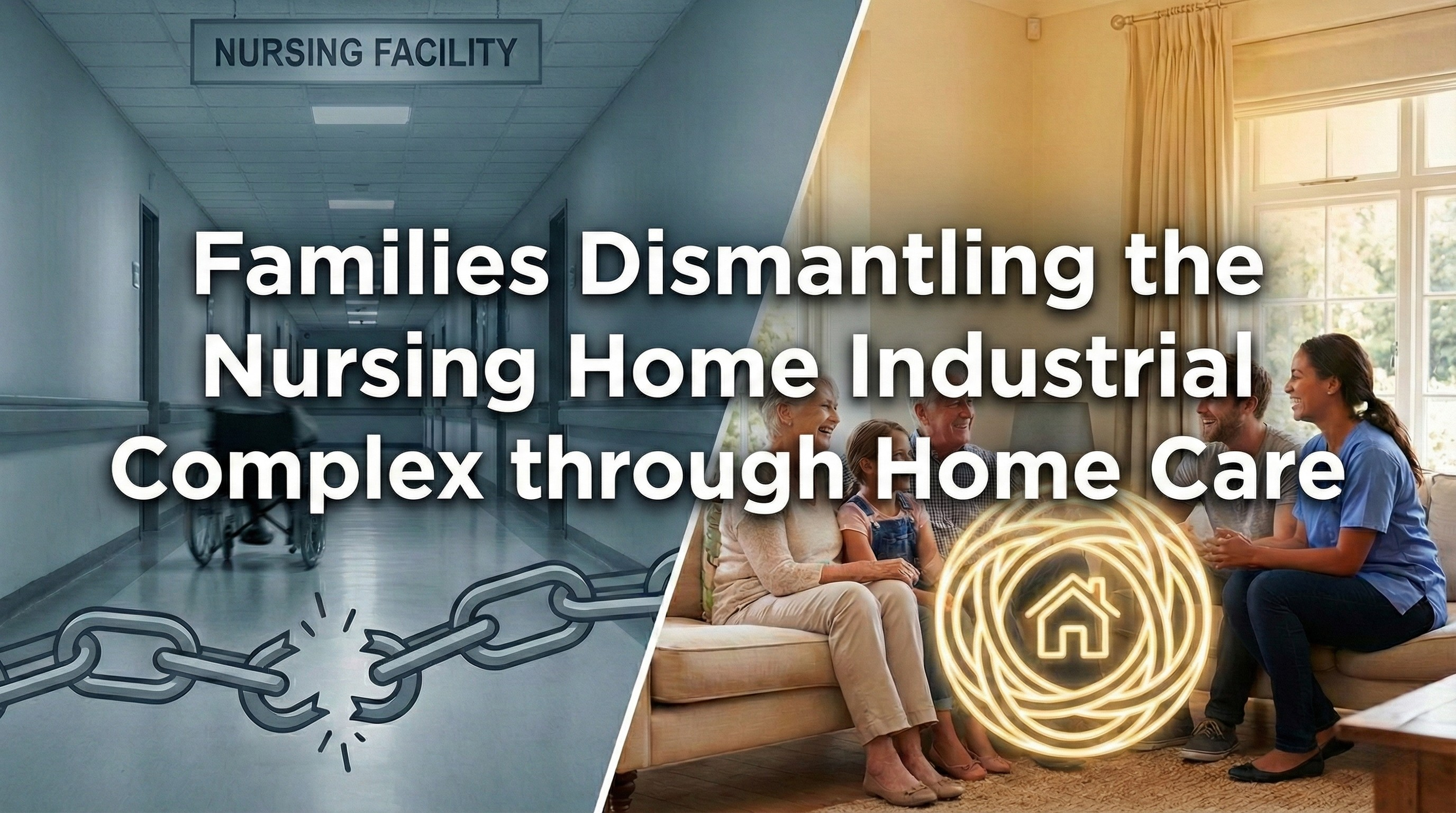
Most families make the nursing home decision in a single moment of panic.
Not after careful research. Not after exploring alternatives. Not after asking what the older adult actually wants.
In the aftermath of a fall, a hospital stay, a crisis, when fear is running the show and everyone's overwhelmed.
That's when the $200 billion nursing home industrial complex makes its pitch. They know exactly when to strike: when families are too stressed to ask the right questions.
Here's what actually happens when families face the nursing home decision. It's not what the industry wants you to believe.
The Panic-Driven Placement Pattern
Most nursing home placements follow the same script.
There's a fall. A crisis. A hospital stay. Then panic.
"We need to do something" becomes the family mantra. The conversation isn't about what Mom wants or what's actually needed. It's about managing fear in the moment when everyone's overwhelmed.
Families operate on feelings, reactions, and stress. Not data. Not validated observations. Just raw panic that leads to permanent decisions.
I ask families the basic questions: What have you done to make the home safer? How are you tracking wellness patterns? What changes have you observed in health or communication?
The answers reveal the gap. Families are making life-altering decisions based on concerns they haven't actually investigated.
But here's what the industry doesn't tell you: It's not the older adults asking to leave home.
It's families saying "You need to go. I'm concerned about you."
Meanwhile, 89% of adults aged 55 or older say they want to age in place in their own homes. Yet only 15% have given serious consideration to how their home might need modification as they age.
That gap between desire and preparation is where the nursing home industrial complex makes its money.
The Outsourcing of Worry
When costs are roughly equal between home care and facility care, families choose the facility.
Not because it's better care. Not because Mom wants it.
Because it feels like less worry. Less coordination. Someone else's problem.
The nursing home sales pitch is elegant in its simplicity: "You won't have to deal with it."
They show you the dining room with catered meals. The activities calendar. The manicured grounds. It's like touring a cruise ship.
What they don't show you: 80% of facilities fall short of providing the highest-quality care due to staffing shortages. As of September 2023, 94% of facilities wouldn't meet federal staffing requirements. In December 2025, the government simply repealed those standards entirely.
The industry couldn't meet basic quality benchmarks, so they eliminated the benchmarks.
Families recognize the pain of placing someone in a facility they don't want to be in. They feel bad about it.
But they get over it.
Because the alternative requires coordination, structure, and tools that simply don't exist in the traditional system.
The Infrastructure Gap Nobody Talks About
We build entire infrastructures for babies.
Apps for tracking feedings. Support groups for new parents. Pediatrician networks. Childcare systems. Educational pathways mapped from birth through college.
For aging? Nothing.
Families have no roadmap, no structure, no plan for when someone older needs help. You're supposed to figure it out in the middle of a crisis while managing your own job, your own family, your own life.
This is where the "family influencer" emerges. Usually a woman. Usually doing all the research, finding answers, coordinating care for the older adult and the rest of the family.
She's operating without a playbook. And she isn't just coordinating tasks, she's absorbing the family's collective grief, managing everyone else's guilt, and carrying the weight of a decision no one else wants to make.
The numbers tell the story: 63 million Americans are caregivers in 2025. The number of family caregivers helping older adults jumped from 18.2 million to 24.1 million between 2011 and 2022. That's a 32% increase in just over a decade.
These aren't professionals. They're family members building solutions in real time because the system offers nothing else.
The Multigenerational Reality
Caregiving now spans every generation.
One in three caregivers is under age 50. Roughly one-third are part of the "sandwich generation," supporting both elderly parents and young children simultaneously.
Then there's the dynamic nobody prepared for: 70-year-olds caring for their 95-year-old parents.
This isn't the traditional parent-child relationship anymore. It becomes more like siblings. Equal nurturing in both directions because both people have significant needs.
The 70-year-old caregiver is managing their own health issues, their own limitations, their own aging process while trying to help their parent stay home.
What breaks first? Usually finances. Or the realization that you can't do it all alone.
The ThriveCircle Model
Sustainability in home care depends on one thing: building a circle of support.
You can't do it alone. At some point, you can't cook every meal. You can't be available 24/7. You can't handle every medical appointment, every medication refill, every moment of loneliness.
The ThriveCircle is family members willing to pitch in plus caregivers who come in to provide assistance. It's the coordination structure that makes aging at home actually viable.
A ThriveCircle isn't just a group chat. It's a roster. It's the neighbor who checks the mail on Tuesdays, the hired aide for showers on Fridays, and the son who handles finances on Sundays. It's the granddaughter who does video calls every Wednesday evening and the friend from church who brings groceries every other Thursday.
Without it, families shuffle the person off to a facility. Not because the older adult needs institutional care, but because the family doesn't have the resources, time, energy, mental bandwidth, or emotional capacity, to coordinate home care.
The human reality: families make someone else's problem when they lack the structure to make home care work.
But what the older adult wants and what the family perceives is needed are often completely different things.
The facility isn't what the older adult wants. It may not even be what they need. But it's what the family perceives solves their coordination problem.
What Actually Makes Home Care Work
When an older adult explicitly states "I want to stay home" and the family commits to that as the actual goal, not just a wish, everything shifts.
Words matter. The stated goal matters.
But stating the goal isn't enough. You need a strategy. A roadmap. Structure and tools.
This is what makes aging at home possible: home safety, wellness tracking, community connection, and financial planning.
You need a plan around each of these areas. You need tools to execute that plan. You need coordination that doesn't rely on one overwhelmed family member holding everything together through sheer force of will.
The caregiving economy reveals the scale of this need: families provide an estimated $470 billion of free labor per year. That's more than double the entire nursing home industry.
Yet 71% of caregivers are financially struggling. The average family caregiver spends $7,200 per year out of pocket on caregiving expenses. Nearly half receive no formal support, no financial aid, no counseling, no respite care, despite 88% saying they need more help.
Sixty-two percent of caregivers wish they could talk to other caregivers who understand what they're going through. Fifty-six percent need reliable tips about day-to-day caregiving.
The gap is massive. The need is clear. The infrastructure simply didn't exist.
The Path Forward
I don't think nursing homes are going away entirely. They serve a purpose for some people in specific situations.
But the message needs to shift. The strategy needs to center on what 90% of people actually want: living at home.
When families have a clear path forward, for the older adult, for themselves, for understanding wellness and connection, what seemed impossible becomes normal.
Peace of mind becomes possible when you're not operating in panic mode. When you have tools instead of just fear. When you have coordination instead of chaos.
This matters especially when you're hundreds or thousands of miles away from Mom living alone as she ages. Anything that creates peace of mind in that situation changes everything about the caregiving experience.
The nursing home industrial complex built itself on family panic, inadequate infrastructure, and the outsourcing of worry.
Families are building something different. Not because they're revolutionaries, but because they're listening to what older adults have been saying all along.
Home is home.
Now we finally have the tools to make staying there possible.
The next time panic strikes, pause. Ask one question: "Is this decision for their safety, or for my anxiety?"
The answer changes everything.