When Is It Time for an Aging Parent to Stop Driving? A Respectful Guide
You walk around to the passenger side of your father's car and freeze. A fresh, deep scrape extends from the front wheel well across the passenger door, accompanied by a cracked side-view mirror. When you ask about it, he brushes it off: "Someone backed into me in the supermarket parking lot and took off."
Two weeks later, your mother mentions that Dad got disoriented on the way back from his routine hardware store run and took an hour and a half to find the highway exit.
Few conversations in senior care carry more emotional freight than handing over the car keys. In American culture, a driver's license is not merely a piece of plastic in a wallet; it is the ultimate symbol of adulthood, agency, freedom, and spontaneous life. Taking away the keys feels, to an older adult, like a sentence of house arrest.
Yet driving requires split-second neurological choreography: sharp visual contrast, rapid peripheral scanning, cognitive processing speed, and sudden physical reflexes. When those faculties erode, the stakes become catastrophic—not just for your parent, but for pedestrians and other families on the road.
Here is your compassionate, step-by-step roadmap to assess driving fitness objectively, arrange professional evaluations, and build a dignified post-driving transportation life.
Facing Tough Family Decisions?
Navigating the transition away from driving is one of the hardest conversations a family can have. Use SeniorThrive's structured 5-Question Family Framework to keep discussions productive, calm, and grounded in mutual respect.
The 8 Objective Warning Signs of Driving Risk
Rather than arguing about age (which is meaningless—many 85-year-olds drive safely, while some 68-year-olds do not), evaluate specific behavioral markers:
| Warning Sign | What You Observe | Underlying Clinical Cause |
|---|---|---|
| 1. Unexplained Dents & Scrapes | New scratches on fenders, mirror casings, or garage door frames with vague explanations. | Spatial disorientation, reduced peripheral vision, or difficulty judging clearance while parking. |
| 2. Lane Drifting & Curb Bumping | Riding the centerline, drifting onto the rumble strip, or scraping tires on curbs during turns. | Impaired visual tracking, slow neck rotation due to arthritis, or micro-sleep episodes. |
| 3. Pedal Confusion & Sudden Braking | Tapping the gas instead of the brake, or hitting the brakes erratically in flowing traffic. | Peripheral neuropathy (numbness in feet) or delayed motor coordination. |
| 4. Getting Lost on Familiar Routes | Taking an hour to return from the local pharmacy or missing familiar highway exits. | Executive function decline or early spatial-working-memory impairment. |
| 5. Driving Far Under the Speed Limit | Driving 35 mph on a 55 mph highway out of anxiety, causing dangerous backups. | Compensation for delayed visual processing speed and fear of fast stimuli. |
| 6. Delayed Reaction to Traffic Signals | Sitting through green lights until someone honks, or missing stop signs completely. | Diminished selective attention; inability to filter visual clutter at intersections. |
| 7. Near-Misses and Close Calls | Frequent close calls at left-hand turns, merges, or four-way stops. | Impaired dynamic depth perception and time-to-arrival calculation. |
| 8. Passenger Anxiety | Spouses, friends, or grandchildren quietly refusing to ride in the car with them. | Social intuition recognizing unsafe driving habits before formal testing occurs. |
Take Yourself Out of the Crosshairs: The Certified Driver Rehab Specialist (CDRS)
When an adult child demands that a parent surrender their keys, the parent hears: "My child is bossing me around and treating me like an infant." It creates immediate, fierce resistance and damages your relationship.
The solution is to outsource the evaluation to an impartial medical professional: a Certified Driver Rehabilitation Specialist (CDRS). These are occupational therapists with specialized clinical training in mobility, vision, and behind-the-wheel testing.
- Clinical Exam: Tests reaction time, contrast sensitivity, visual fields, cognitive processing speed, and neck/leg range of motion.
- Behind-the-Wheel Drive: A 45-to-60 minute drive in a dual-controlled vehicle through real-world traffic, parking lots, and highway merges.
- The Outcome: The CDRS provides an objective written report. If adaptive equipment (pedal extenders, wide-angle mirrors) can solve the issue, they prescribe and train for it. If driving is no longer safe, the recommendation comes from a medical expert—not a nagging son or daughter.
You can locate a certified specialist through the Association for Driver Rehabilitation Specialists (ADED) directory.
---The Step-by-Step Transition: Replacing the Car Before Taking the Keys
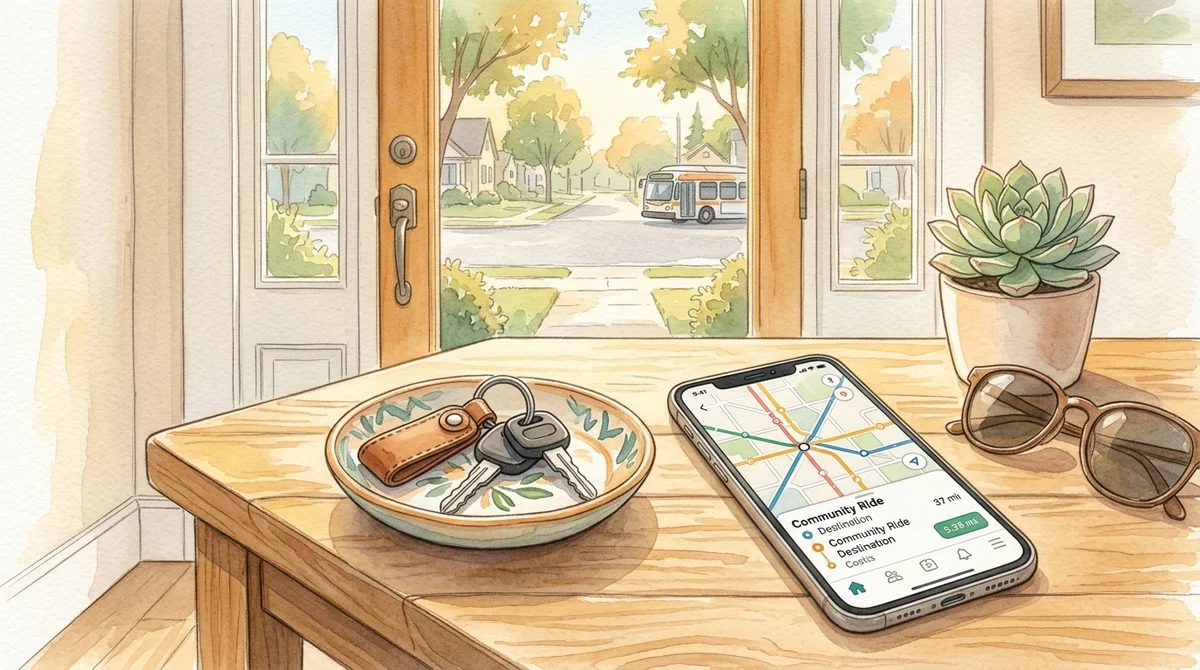
The single biggest mistake families make is seizing the keys without having a viable mobility replacement already running. When you take the car away without an alternative, you strand your parent in isolation.
Step 1: Calculate the Real Cost of Car Ownership
Most seniors believe that keeping their 10-year-old car is cheap because it is paid off. In reality, AAA estimates that car ownership (insurance, annual registration, oil changes, gas, tire replacement, unexpected maintenance) costs $400 to $700 per month.
If you sell the vehicle, that $5,000 to $8,000 annual budget becomes a dedicated VIP Transportation Fund that can easily pay for several weekly Uber or Lyft rides, senior van vouchers, and personal driver services.
Step 2: Build the Multi-Tiered Ride System
- On-Demand Ridesharing Without Smartphones: Services like GoGoGrandparent allow seniors to call a toll-free number from an ordinary landline or flip phone to order an Uber or Lyft with 24/7 operator dispatch.
- Community Volunteer Driver Programs: Many local Area Agencies on Aging (AAA) and faith-based non-profits provide free or low-cost volunteer door-to-door rides for medical appointments and weekly grocery shopping.
- Family Driver Rotations: Create a shared calendar where siblings and grandchildren take turns providing rides for Sunday church, hair appointments, or dinner outings.
Exact Scripts: How to Have the Conversation
The Opening: Focus on Protection, Not Incompetence
"Dad, I want to talk about driving. You have driven for sixty years without a major accident, and I admire how independent you've always been. But traffic today is faster and more aggressive than it used to be. Seeing that dent on the fender scared me because I cannot bear the thought of you getting hurt."
Proposing the Objective Test
"Rather than you and me arguing back and forth, let's schedule an evaluation with an occupational driving specialist. If they say your reflexes are good, I will drop the subject. If they identify problems, we'll look at the recommendations together."
Framing the Transition Dignified
"Giving up driving does not mean staying stuck at home. We're setting up a ride account so you can go anywhere you want—the diner, the pharmacy, your card games—without having to worry about parking, icy roads, or reckless drivers. You'll have a private driver on call whenever you need one."
Frequently Asked Questions
Can a doctor revoke someone's driver's license?
In most states, a physician cannot unilaterally cancel a driver's license, but they are either required or permitted to submit an official medical report of unsafe driving to the state Department of Motor Vehicles (DMV). The DMV then requires the driver to undergo a formal re-test, vision exam, or medical review.
What should you do if an aging parent with dementia refuses to stop driving?
When cognitive impairment makes rational conversation impossible, safety must take absolute priority. Strategies include asking their physician to write an official "do not drive" prescription, filing an anonymous safety report with the DMV, disabling the vehicle (disconnecting the battery cable), or moving the car out of sight to a family member's garage.
How much does a certified driving evaluation cost?
A comprehensive clinical and behind-the-wheel driving assessment by a Certified Driver Rehabilitation Specialist (CDRS) typically costs between $400 and $800. Medicare rarely covers the on-road portion, though clinical occupational therapy components may be partially reimbursed with a physician's referral.