What Is a Home Safety Score? How to Measure Aging-in-Place Readiness
If you walk through your aging parent's home and ask yourself, "Is this house safe?", your intuition will almost certainly mislead you. You will look at the clean living room carpet, the tidy kitchen counters, and the comfortable armchair and think everything looks fine. But fall hazards in residential homes are rarely dramatic; they are subtle, structural, and quiet.
For years, eldercare checklists and wellness apps attempted to quantify this with a single summary score—a "ThriveScore" or "Safety Grade" that averaged everything together into an attractive number like 88%. But in fall prevention, an average score is dangerous. An 88% safe home is not safe if the remaining 12% is a slippery fiberglass tub without a grab bar. That single untouched hazard is where a hip fracture happens.
The Home Safety Score was engineered to replace vague generalities with a strict, room-by-room deduction model rooted in occupational therapy standards. Below is how the scoring methodology works, how points are deducted, and how to systematically clear hazards from your home.
The Governing Principle: The House, Not the Person
The Home Safety Score measures physical hazards in a house—it never measures a person. It does not assess cognitive decline, medical frailty, or personal independence. Attaching a numeric score to an older adult's wellbeing is fundamentally flawed. The Home Safety Score evaluates the physical environment: floor transitions, lighting levels, reach heights, and grab bar anchoring. A house can be made safer; a person should never be scored.
How the Scoring Model Works: The Room-by-Room Method
Rather than producing one blended number that averages a hazardous bathroom away with a clean dining room, the Home Safety Score evaluates each living space independently.
Every completed room begins with a baseline of 100 available points. When a physical hazard is identified during an assessment or scan, points are deducted based on clinical severity:
| Severity Tier | Point Deduction | Clinical Definition | Real-World Examples |
|---|---|---|---|
| Critical Hazard | -25 Points | Immediate slip/trip risk during unassisted daily transitions; high probability of severe injury | No grab bars in wet shower stall; broken stair nosing; missing handrail on stairs |
| High Hazard | -15 Points | Frequent friction point; unstable support during fatigue or nighttime navigation | Throw rug without rubber backing; pathway blocked by low coffee table; dark hallway under 30 lux |
| Moderate Hazard | -10 Points | Environmental strain requiring awkward twisting, stretching, or reaching on tiptoes | High microwave reach above shoulder level; loose toilet seat; doorway threshold over 0.75 inches |
| Low Hazard | -5 Points | Secondary accessibility barrier or maintenance deficiency that increases fatigue | Doorknob requiring strong grip (vs lever handle); clutter along perimeter walls |
The Weakest Link Rule: Why Your Lowest Score Dictates Safety
Most consumer safety audits make the fatal error of calculating an aggregate mean: (Living Room 95 + Bedroom 90 + Kitchen 85 + Bathroom 55) / 4 = 81%. The family sees an 81% score and assumes the house is in "Grade B" shape.
In clinical reality, falls do not occur on average; they occur at the point of maximum hazard. An older adult does not fall in the living room because the dining room was clean. More than 70% of catastrophic in-home falls occur in the bathroom and on staircases.
Under the Home Safety Score protocol, your home's safety index is represented as a room breakdown where the lowest-scoring room is flagged as the Primary Intervention Target. If the bathroom sits at 55 points, that bathroom is where 100% of family attention and budget must be directed before buying gadgetry for other rooms.
---The 13 Landmark Findings Catalogue
Through hundreds of in-home reviews and occupational therapy frameworks, the vast majority of residential falls trace back to thirteen specific, repeatable physical findings:
- The Wet-Zone Grip Deficit: No ADA-compliant wall-anchored grab bar inside the shower or beside the commode (towel racks do not count—they tear off drywall under 30 lbs of load).
- The Stepped Transition: A raised floor threshold greater than 0.5 inches between hardwood, tile, or carpeted rooms that catches dragging feet.
- The Floating Throw Rug: Decorative rugs without silicone backing or perimeter double-sided tape that bunch or slide under shuffle strides.
- The Shadowed Night Route: Hallways and bathroom paths falling below 30 lumens/lux between 10:00 PM and 6:00 AM.
- The Single-Rail Staircase: Stairs lacking continuous, dual handrails extending past the top and bottom risers.
- The Low Soft Seat: Living room chairs or sofas with low seat heights (under 18 inches) and soft cushions that trap hips below knee level, making standing a strain.
- The Glare Blind Spot: Highly polished floors or bare bulbs creating blinding glare patches for cataract-affected eyes.
- The Overhead Stretch: Essential everyday dishware, pantry items, or clothing stored above eye level, encouraging dangerous ladder or step-stool climbing.
- The Trailing Cord: Extension cords or lamp wiring crossing primary walkways or pinned under rug edges.
- The Unstable Toilet Base: Standard 14-inch low toilets without risers or secure frame supports, forcing deep knee flexes that cause loss of balance.
- The Slip-Prone Tub Lip: High tub walls (16–20 inches) requiring single-leg balance and hip flexion to step into.
- The Twisting Doorknob: Round brass doorknobs that arthritic or wet hands cannot open during urgent bathroom exits.
- The Unsecured Bed Edge: Mattresses that compress excessively at the perimeter, causing slips when sitting down to put on shoes.
To identify which of these thirteen findings exist in your own home, take our free 2-minute Home Safety Check-In or run an in-depth room review via Room Check.
---Remediation Math: How Fixing Hazards Restores Points
A score is only useful if it motivates action. The Home Safety Score operates on a closed restoration loop: when a hazard is remediated, the exact points deducted are restored to that room's score.
| Initial Finding | Deduction | Specific Action Required | Points Restored |
|---|---|---|---|
| No grab bar in tub | -25 | Install two 1.25" stainless grab bars into studs (vertical at entry, horizontal at 34") | +25 |
| Unsecured runner rug | -15 | Apply perimeter rug grip tape or remove rug entirely | +15 |
| Dark hallway to bathroom | -15 | Plug in two automatic amber motion-sensor nightlights (under 2700K) | +15 |
| High pantry reach | -10 | Reorganize daily canned goods and cookware between waist and shoulder height | +10 |
Home Safety Score vs. Professional In-Person Assessment
How does a digital Home Safety Score compare to an on-site evaluation by an Occupational Therapist (OT) or Certified Aging-in-Place Specialist (CAPS)?
They are complementary stages of the same continuum:
- The Home Safety Score (Preliminary Stage): Serves as a fast, accessible, free screening tool. It highlights obvious structural red flags (lighting, rugs, missing bars) that families can address immediately without waiting six weeks for an appointment.
- The Comprehensive Home Assessment (Clinical Stage): Conducted by an OT or physical therapist. It observes the interaction between the individual's specific biomechanics (gait, range of motion, cognitive processing) and the physical environment. (Read our full guide on What is a Home Safety Assessment? to understand clinical evaluation criteria).
Comparing the cost of modest home modifications ($300 to $1,500) against the astronomical expense of fall recovery ($40,000+ for an emergency room visit and rehabilitation stay) makes the return on investment unmistakable. See the breakdown in our interactive Value Calculator.
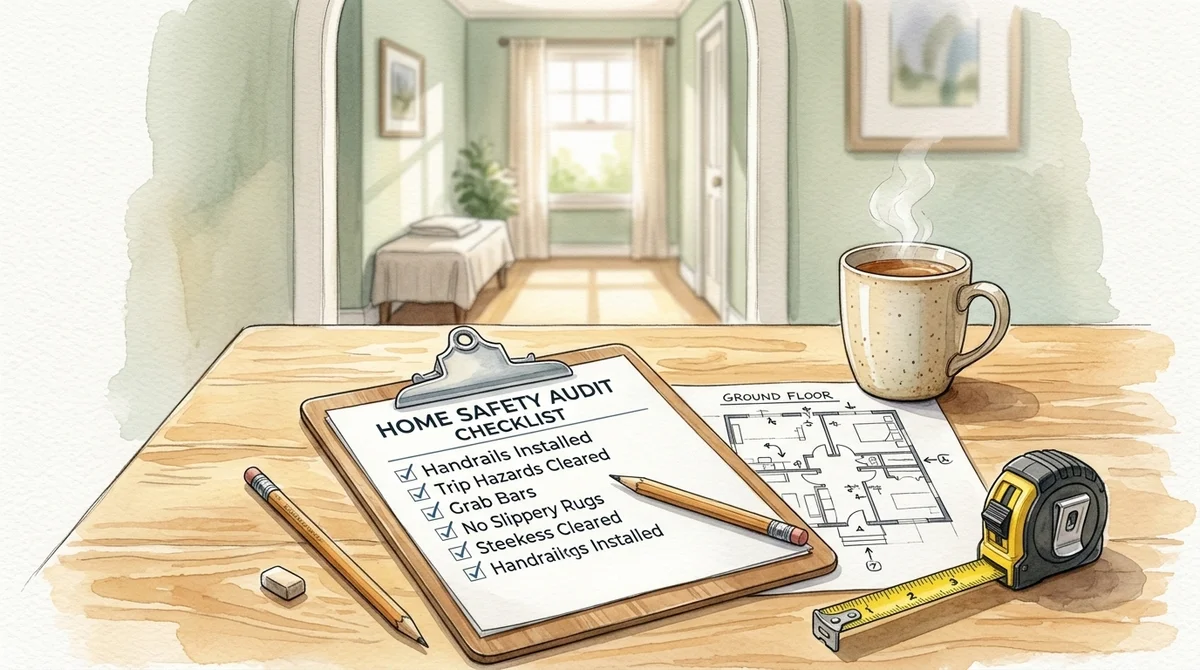
---Where to Begin: The 3-Step Home Audit Protocol
-
Step 1: Start with the Wet Zones
Audit the primary bathroom first. Check tub entry, grab bar anchoring, and toilet transfer stability. If the bathroom score is below 80, do not spend money on living room decor or electronic gadgets until the wet zone is secured. -
Step 2: Inspect Every Foot of the Night Route
Turn off all lights at 9:00 PM. Walk the exact path your parent takes from their pillow to the toilet. If there is a single dark patch where feet step blindly, install motion-activated plug-in nightlights immediately. -
Step 3: Align the Sibling Group Around Objective Findings
Subjective conversations ("Mom's house feels cluttered") spark defensive arguments. Objective hazard scores ("The hallway has two tripping thresholds and measures below safe lighting standards") turn conflict into a clear punch list. Review The SeniorThrive 5-Question Framework to keep siblings aligned.
Frequently Asked Questions
What is a good Home Safety Score?
Because scores are calculated room by room rather than as a single average, a safe home is one where every primary living area (especially the bathroom, bedroom, stairs, and kitchen) scores 90 points or higher. Any room scoring below 75 points represents an active hazard zone that requires prompt remediation before a fall occurs.
Why does the Home Safety Score avoid combining everything into one number?
A single blended score is clinically misleading. If three clean, hazard-free rooms score 100 but the bathroom scores 50 due to a slippery tub and missing grab bars, an aggregate score would read 87.5%—giving the family a false sense of security while leaving a lethal fall hazard completely unaddressed.
Does the Home Safety Score evaluate health or dementia?
No. The Home Safety Score measures physical and environmental hazards in the house—it never scores the person. It evaluates floor transitions, lighting levels, grab bar anchors, and obstacle clearances, avoiding inappropriate or unqualified clinical health claims.
How much does it cost to raise a low Home Safety Score?
Many high-impact safety improvements cost under $30: plug-in motion nightlights ($15), rug gripper tape ($12), non-slip shower mats ($18), and moving high-reach items to waist height ($0). Professional grab bar installation into wall studs typically costs between $150 and $300 per bathroom.
Can grab bars be mounted with suction cups?
No. Suction-cup grab bars are strongly discouraged by occupational therapists and safety engineers. They routinely lose suction due to grout lines, temperature changes, and steam, pulling free from the wall precisely when someone relies on them during a fall. Only wall-anchored grab bars screwed into structural wall studs or certified hollow-wall anchors provide safe support.
How often should a home safety score be updated?
A home safety review should be re-evaluated every 6 to 12 months, or immediately following any change in mobility, a new medication regimen causing dizziness, a hospital discharge, or after any seasonal transition (such as entering darker winter months).