

Ask Your Pharmacist About Cannabis. Here's How to Start.
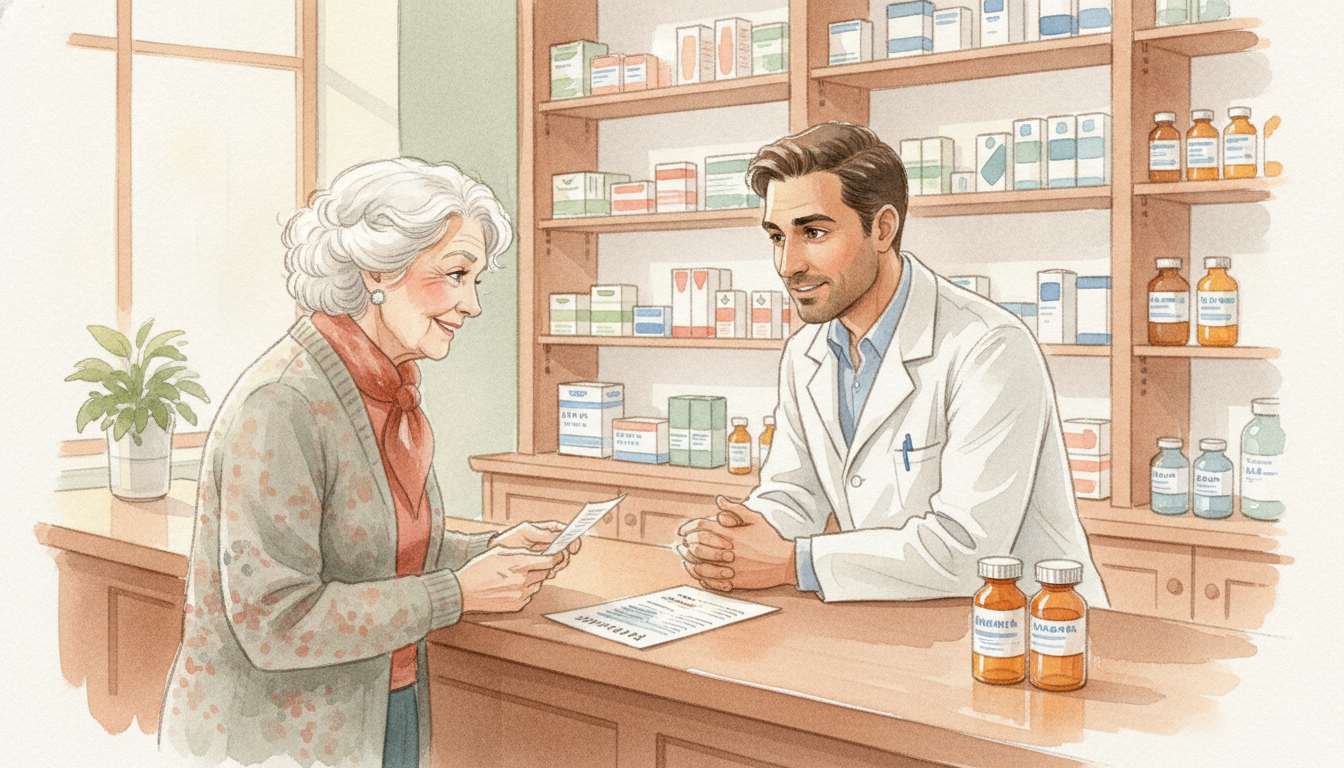
If you are thinking about trying cannabis, you probably have a short list of real questions. Will it help? How much do I take? Will it clash with my blood pressure pill? Am I going to feel like an idiot in front of my grandchildren?
Those are good questions and they have answers. Here are the ones we can give you, and the one person who can give you the rest.
You are not the only one wondering
In 2023, 7 percent of Americans over 65 used cannabis in the past month, up from 4.8 percent two years earlier. That is the highest figure ever recorded for this age group, and it comes from a study by Benjamin Han and colleagues in JAMA Internal Medicine.
The University of Michigan asked 3,379 adults over 50 why they use it. Relaxation came first, at 81 percent. Then sleep, at 68 percent. Then enjoyment, at 64 percent, ahead of pain at 63 percent.
Enjoyment. Ahead of pain. Not everyone is medicating, and there is no need to dress it up as medicine if it is not.
What it has been reported to help with
On pain, the evidence is genuinely strong. In 2017 the National Academies of Sciences, Engineering, and Medicine reviewed the research and concluded there is conclusive or substantial evidence that cannabis and cannabinoids help with chronic pain in adults. Patients treated with it "were more likely to experience a significant reduction in pain symptoms."
Sleep and anxiety sit lower down that same review. The National Academies put short-term sleep improvement in its "moderate evidence" tier, and only for people whose sleep is disturbed by specific conditions such as chronic pain, fibromyalgia, multiple sclerosis or obstructive sleep apnea. Anxiety landed in the "limited evidence" tier, narrower still.
That is the same body, grading the same way, reaching a weaker conclusion. Anyone telling you sleep is settled science is going further than the evidence does.
It is not the cannabis you remember
This is the one that catches people out, and it catches out the ones who feel most confident.
If you last tried this in 1974, you are picturing something several times weaker than what is on a shelf today. Dr. Peter Grinspoon of Harvard Medical School puts it plainly: "Three bong hits now is more like 20 to 30 bong hits used to be."
Harvard Health reports that about a fifth of older adults underestimate how much stronger it has become. That gap between what you expect and what you get is what turns a pleasant evening into a frightening one.
If you try it, here is the shape of it
Harvard Health's guidance for older adults is four words: start low, go slow.
Start smaller than you think. For someone new to THC, Dr. Grinspoon suggests products containing only 1 to 2.5 milligrams per use, and suggests starting with CBD rather than THC. Read the label for milligrams per piece before you read anything else on the package. If one piece holds more than that, cut it.
Wait longer than you think. The CDC says edibles "take from 30 minutes to 2 hours to feel intoxicating effects, so some people may eat too much, which can lead to poisoning and/or serious injury." That delay is the trap: nothing is happening, so you take more, and then both doses arrive together. Take one, put the tin away, and give it the full two hours.
Consider the form. Harvard advises tinctures or edibles over smoking, because cannabis smoke carries carbon monoxide and benzene along with everything else. If your lungs are already a consideration, that decides it.
Pick your evening. Nowhere to be, nobody arriving, nothing on the stove.
What is different about an older body
Three things, and they are the reason this article exists rather than a general one.
You process it differently. Harvard Health notes that older adults are more vulnerable to cannabis side effects in part because of how aging bodies handle the drug. The same amount can land harder and linger longer than it did at 40.
Balance is the real risk. Harvard singles out falls as a particular vulnerability for older adults, and dizziness and sedation are among the effects behind that. At 78 a stumble is not the event it was at 48. If you already take something that makes you drowsy, adding a second thing that does the same is how people end up on the floor.
Interactions are real and specific to your list. Harvard is direct that many common prescriptions can interact with cannabis. Which ones, for you, depends entirely on what is in your cabinet. Nobody can answer that from an article, including this one.
Which brings us to the part most people skip.
Talk to your pharmacist. Most people don't.
In that Michigan poll, 44 percent of people using cannabis at least monthly had never mentioned it to any healthcare provider.
Nearly half. Managing it alone, guessing at the interaction question, hoping.
It does not need to be that way. A pharmacist has your full medication list, knows what interacts with what, and fields this exact question all day. It is free, there is no appointment, and you do not have to buy anything. Your doctor is the other right answer, but a doctor's appointment is three weeks out and the pharmacy is open Saturday.
People skip it because it feels like a confession. It isn't. Fish oil goes on the list, ibuprofen goes on the list, and so does this. Pharmacists are not there to judge what you take. They are there to see the whole list and tell you what to watch for.
A pharmacist who does not know cannot warn you. That is the entire argument.
Four questions to bring
Bring your medicine list, or just carry the bottles in a bag.
1. Here is everything I take. I am thinking about trying cannabis. Does anything here worry you?
2. Does anything on this list already make me dizzy or drowsy?
3. What should I watch for in the first few days?
4. If something feels wrong, do I call you or my doctor?
Write the answers down while you are standing there. You will not remember them in the car.
Four things to get right regardless
Driving. The CDC is blunt: "Driving under the influence (DUI) laws are not just for alcohol. Driving under the influence of drugs, including cannabis, is also dangerous and illegal." And: "If you intend to drive, the safest option is not to use any alcohol or drugs, including cannabis." Not later that evening. Not just to the shop.
Mixing. "Studies have shown that the use of multiple substances (such as cannabis and alcohol) at the same time can increase impairment." A glass of wine counts.
Storage. Keep it "in a locked childproof container and out of the reach and sight of children and pets." Grandchildren visit, and a gummy on the counter does not look like medicine. If anything happens, poison control is 1-800-222-1222, or 911 in an emergency.
Where you buy. Laws vary by state and by town, and legal is not the same as licensed. Your state regulator publishes a list of licensed dispensaries. Trust that list over any map search, ours included.
Then we make it easy
Say you have the conversation and your pharmacist says it is reasonable for you to try. The hard part is behind you. The rest is just keeping track of things, and keeping track of things is what we do.
SeniorThrive has a Dispensary Finder in Daily Life. Switch it on and it will show you what is nearby, let you save the places you actually use, and hold an online one in the same list if that is how you order. Each entry keeps the name, the address, the phone number and whatever note you leave yourself, so next time you are not standing in the kitchen trying to remember what that place on Third Street was called.
It is the same thing we do with pharmacies, for the same reason. Something written down once is something you never have to hunt for again.
What it will not do: check your medicines or flag interactions. That is your pharmacist's work and we are not going to pretend to do it. It does not verify listings either, so check your state's licensed list before you go somewhere new. And it stays off until you switch it on. Nobody in your Circle is told you opened it, or that you turned it on at all.
The decision is yours and your pharmacist's. The remembering is ours.
Go have the conversation. We will be here for the rest.
This article is for general information and is not medical advice. Talk to your doctor or pharmacist about your own situation.
See how SeniorThrive helps you keep the details of daily life in one place.